


Author Archives: Nolen Walker

  • plumbing heating and air alliance member
  • contractors of america best digital agency
  • expertise.com best seo agencies in fort worth

HVAC Facebook Ads: 11 Suggestions To Consider


I’m not going to sugarcoat anything. Homeowners don’t normally log in to Facebook to find a furnace repair service. However, if their AC fails during a summer heatwave or their furnace conks out in the winter freeze, they are influenced by what they see on Facebook.

Earning consumer trust requires more than sticking a “Call Now” button underneath a Facebook ad featuring a stock photo from ten years ago. Instead, it requires a strategy rooted in authenticity and powered by Meta’s modern AI tools.

Whether you’re a one-man show or a multi-van fleet, this Facebook Ads guide for HVAC companies breaks down how to convert everyday scrolling into service calls without blowing your budget on low-conversion clicks.


Cost of Facebook Leads for HVAC Companies

HVAC companies can expect to pay between $2.50 and $5.00 per click for Facebook ads targeting “AC Repair” or “Emergency Furnace Service.”

To maximize ROI, I generally recommend that HVAC businesses focus on Cost Per Lead (CPL), which averages $35-$55 for well-optimized Meta Lead Ads.


Facebook Ad Tips for HVAC Companies

The HVAC industry is very technical, and as a contractor, you may not have the time or expertise to devise an effective Facebook ad campaign. But that doesn’t change the fact that Facebook ads can have a huge impact on your business. 

If you have never considered using Facebook ads, now is certainly the time. If you are interested or already have a social media advertising campaign in place, we want to help you make it more effective.

In the following guide, HVAC Webmasters will highlight tried and true Facebook ad strategies to help you get the highest ROI on your social media ad campaign. 

HVAC Facebook Ads Cover

1) Invest in High-Performance Creative

Authenticity outperforms production value for HVAC Facebook ads. That’s why stock photos featuring paid actors holding wrenches fall flat in conversion rates.

You can boost your performance by leaning into UGC (User-Generated Content). Simply film a 30-second video on your smartphone featuring an expert HVAC tip or a walkthrough of a job.

These raw videos earn 4x more trust than polished infographics. Keep in mind that while captions are helpful, an increasing number of Reels consumers are browsing with audio-enabled devices.


2) Keep Your Ads Short

Did you know that Facebook allows you to create video ads that are as long as 241 minutes? That’s a lot of creative freedom, but when was the last time you watched an ad that was longer than a movie? The best practice is to keep your video ads short.

The American attention span is getting shorter almost every year. Nowadays, you can get your point across in just a few seconds without losing your target audience’s focus. GIF (Graphics Interchange Format) is an excellent tool for creating cheap, short, and compelling ads for your HVAC business. 

Concise Facebook Ads perform better for HVAC companies than long, complicated ads.


3) Optimize for Mobile

People watch Facebook video content on their phones more than half the time. Nowadays, you must optimize every aspect of your online presence (your website, landing pages, etc.) for mobile. The same goes for your static and video ads.

Be aware that just because your ad has earned you many clicks on a desktop doesn’t mean it will play well on mobile devices. Smaller file ads usually work better for mobile users, but test all your Facebook ads on a mobile device. 

Most Facebook users access the social media platform through its mobile app, making it imperative to optimize smartphone ads.


4) Use Professional Management Tools

The Meta Ads manager mobile app is helpful for daily stats, but the Desktop Meta Business Suite is the go-to tool for creating a professional campaign.

Meanwhile, the Meta Advantage+ AI engine automatically tests your headlines, images, and placements to maximize conversions for your target consumers.


5) Leverage AI-Driven Retargeting

Retargeting remains effective for high-ticket services such as full system replacements. However, it’s evolved beyond website visitors into existing customers and prospects who’ve engaged with your business.

You can utilize Meta’s Conversions API to sync your CRM data directly with your ads. The Advantage+ AI Retargeting tool will do the heavy lifting by identifying which of your past interactions are most likely to convert.


6) Use Dynamic Creative Optimization (DCO)

Before AI, many professionals recommended A/B testing for Facebook Ads. The problem for local HVAC companies is that their campaigns rarely generate the thousands of clicks required to conduct a reliable A/B test. Today, HVAC companies can simply rely on Meta’s Dynamic Creative Optimization (DCO).

Here’s how it works: You provide Meta with 3 videos, 2 headlines, and 2 descriptions. From there, Meta’s AI mixes and matches these combinations with each individual user. It tests their performance in real time and optimizes your budget automatically based on the response.


7) Focus on Placement-Specific Creative

Instead of relying on cookie-cutter templates, HVAC companies should focus on Placement-Specific Vreative. Your ad should resemble a Reel when it’s featured in Reels and a personal post when it’s in the primary feed.

Meta’s Advantrage+ Creative enhancements can automatically add music and visual filters to ensure you blend into its placement and align with the app’s current trends.


8) Use Conditional-Logic and High-Intent Forms

Modern Lead Ads should include filtering to create more friction and result in more qualified leads. Examples of a filtered step include a pre-screening question such as “Are you a howmoner” or “Is your system older than 10 years.”

The form will simply send for users who answer “No,” while continuing to collect contact information for users who answer “Yes.” While you might fear losing leads with this measure, the macro-level impact will be a higher ROI and less wasted ad spend.


9) Use Precision Tracking

The Facebook Pixel is no longer sufficient to accurately track the ROI of your ad campaign. Instead, you must integrate a Hybrid Tracking System that uses both the Meta Pixel and the Conversions API.

This server-to-server connection bypasses ad-blockers and IOS privacy restrictions, ensuring that it can identify customers who call from a Meta Ad and serve that ad to similar users.


10) AI-Driven Spec Optimization

Manual specifications are obsolete. Simply upload a high-res photo or video, and Meta AI will automatically crop, brighten, and rearrange your ad elements to fit each placement. That includes vertical Reels to square Feed posts.

Your goal is to upload great content and allow the algorithm to optimize the technical formatting to reach the right users in the right place.


11) Target Your Local Market

Focusing on your local market is best, since any HVAC business will be local. Luckily, Facebook lets you target your ads to users in your area.

You can further refine your audience based on age, gender, interests, and more, but localizing your ads should be your priority as an HVAC contractor.

If you don’t use any other targeting criteria, at least use local market targeting. Facebook’s Advantage+ audience targeting will take care of the rest.


Facebook Advertising Services for HVAC Contractors

Embracing Meta’s Advantage+ AI is the key to successful Facebook Ads campaigns in the HVAC industry. Companies still relying on stock photos or generic videos are being overtaken by authentic, technician-led short videos.

With Facebook Ads, you’re not merely buying clicks; you’re forming an online presence and reputation. I recommend auditing your current tracking setup and ensuring you use the Conversions API to convert more scrolls into scheduled appointments.

If you need further assistance with your Facebook Ads campaign, contact HVAC Webmasters for Meta Ads management services.


Nolen Walker

Author: Nolen Walker

Nolen Walker is the founder of HVAC Webmasters and the creator of DataPins™, a Local SEO platform for HVAC companies. He has over 16 years of experience helping HVAC businesses grow through organic search, Google Maps, and AI-driven visibility.

Nolen is the author of A Complete SEO Guide for the HVAC Small Business Owner . He also hosts The HVAC Marketing Plan Podcast and The Nolen Walker Podcast on Spotify.

  • plumbing heating and air alliance member
  • contractors of america best digital agency
  • expertise.com best seo agencies in fort worth

The Essential HVAC Google Ads Guide


Google Ads is an online advertising platform for HVAC companies and other businesses to promote their services through ads on Google Search, YouTube, and other web entities within Google’s Display Network.

Below, HVAC Webmasters outlines everything you need to know about Google Ads for HVAC.  


Key Takeaway

Google Ads for HVAC companies have evolved from manual bidding to AI-powered lead generation. For local success, HVAC companies can prioritize Local Service Ads (LSA) and Smart Bidding to outperform competitors who rely on outdated strategies.


Google Ads for HVAC (Blog Cover)

Google Ads Basics for HVAC

One of the essential assets that Google Ads affords its customers is audience targeting. This is crucial for HVAC customers who run a local business.

After all, what good would it do to have your ads run in New York when you operate in Kentucky?

Understanding the basics of Google Ads prevents your HVAC company from overspending on advertising campaigns.


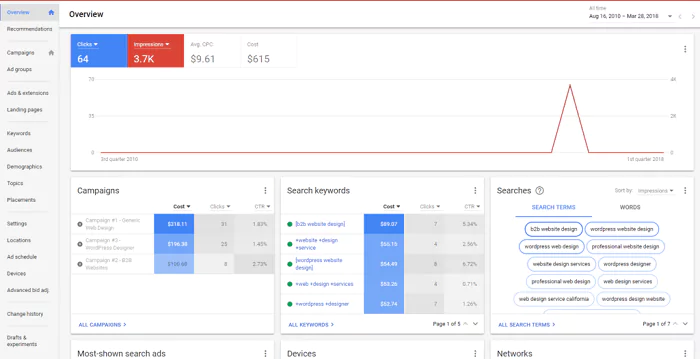
Google Ads Dashboard (Screenshot)

Geo-Targeting

The first thing you need to know about Google Ads for HVAC is that you can pinpoint a specific display location for web surfers. Geo-targeting will help you reach people that you can reasonably service. 


Keyword Research

The second thing you need to know is which keywords you choose and bid on are very important. We will get to the bidding process in a bit. You must ensure you have a list of keywords you want to rank.

For example, if you want an ad that promotes your A/C tuneup service, you would choose keywords that are directly related to A/C tuneup, like “AC tuneup services,” “AC efficiency,” “Air conditioner maintenance,” and the like. 


AI-Powered Search

Google Ads uses AI-powered matching to connect your heating and cooling services with homeowners. Instead of looking for exact words, Google prioritizes search intent. For example, if a homeowner searches for “my house won’t heat,” Google’s AI can assign “emergency furnace repair” as the intent and show your ad accordingly.

To maintain oversight, HVAC companies can use the Negative Keyword List to prevent ads from appearing for DIY or career-related queries.


Smart Bidding

Modern HVAC ad campaigns use Smart Bidding (e.g., Maximize Conversions or Target CPA). Instead of bidding on a specific keyword, you tell Google, “I’ll pay $100 for a booked appointment.” Google’s AI then adjusts your bid in milliseconds based on the likelihood that the user will convert into a customer.


A Primer on Google Ads for HVAC

Now that you know some of the basics of Google Ads for HVAC, let’s consider how you can maximize your investment.


Headline Practices

First and foremost, your headlines must align with the content visitors will read or hear about when they click the ad.

So if your ad headline reads “Furnace Repair,” you’d better ensure the landing page is at least chiefly about furnace repair. Also, it helps to include the keyword in your headline. 


Ad Assets

Ad Assets (formerly Extensions) are crucial to your ad’s Quality Score. Beyond just phone numbers and links, ads include image assets (e.g., branded trucks) and business logos.

Google can also use Automatically Created Assets, where AI grabs headlines and descriptions directly from your website to match the user’s specific query in real time.


First-Party Data and Retargeting

Traditional retargeting has evolved because of increased privacy regulations. The most effective way to stay in front of users who have engaged in the past is through Customer Match.

By uploading an existing customer email list (typically via ServiceTitan or Housecall Pro), you can target existing customers with ads such as Maintenance Reminder and similar offers.


Use Conversion Tracking

Conversion tracking is another Google tool, and it’s invaluable if you use Google Ads for HVAC.

Conversion tracking gives you critical insights into how well your ads are performing.

The data it provides can help you tweak your ads as needed and accurately calculate your advertising ROI


Google Ad Types


Here are the main types of Google Ads:


  • Local Service Ads (LSA): These ads appear at the top of results with a “Google Verified” badge. These ads are pay-per-lead instead of traditional pay-per-click.
  • Performance Max: A “catch-all” ad type that shows your ads across Search, YouTube, Maps, and Gmail simultaneously.
  • Search Ads: Traditional text-based ads for high-value keywords such as “AC repair near me.”
  • Demand Gen: Visual ads on YouTube and Discover for brand awareness

Creative-First Strategy

Google’s AI can auto-generate videos from your website photos. However, homeowners engage most with Authentic Video Assets. Vertical videos (YouTube Shorts) that feature your staff explaining a repair or showcasing an installation outperform generic AI-created slideshows.

YouTube Ads generally perform well, with 87% of U.S consumers saying they took action after learning about a brand through YouTube or Google feeds.


The video AI feature can prioritize one of three goals:

  • Awareness: Maximize the visibility of video ads
  • Consideration: Increase the number of engaged views of video ads
  • Conversion: Optimize video ads for a conversion goal like lead generation or website traffic


Quick Google Ads Tips for HVACR

It’s essential to understand every keyword your ad campaign targets and why. Blindly bidding on recommended keywords is a common pitfall for novice HVAC companies.

Here are a few extra tips to help you get the most out of Google Ads for HVAC companies:


Target Long-Tail Keywords

Google’s AI can find less expensive queries for companies on a tight budget. If you provide a broad theme like AC Repair, Google’s AI will find long-tail versions such as “why is my outdoor AC unit making a buzzing sound” because it knows those clicks cost less and are more likely to meet your Target CPA.


Invest in Good Copy

No matter how much you pay for your ad, the copy will influence your conversion rates. That’s why it’s critical to take the time to write compelling ad copy or hire an agency/freelancer. There’s no sense in investing in the campaign only to take shortcuts with the copy.


Closely Monitor Performance

Keep a watchful eye on how many new HVACR leads you get from your Google ads. Google Ads can be highly effective when properly analyzed. However, it’s essential to monitor their performance regularly.

You can even tweak high-performance ads for better conversion.


Maximizing Your Google Ads Campaign

Google Ads has evolved from a bidding war into a sophisticated AI-driven ecosystem that rewards trust, transparency, and response.

Gaining Google Verified status and leaning into Smart Bidding put your HVAC company in a position to maximize ROI for your Google Ads campaigns.

You don’t have to outspend the big box franchises to succeed with Google Ads. Instead, you can outperform them based on responsiveness and reputation.

If you need assistance with your Google Ads Management, you can learn more about how our PPC ad services can bolster your conversions.


Nolen Walker

Author: Nolen Walker

Nolen Walker is the founder of HVAC Webmasters and the creator of DataPins™, a Local SEO platform for HVAC companies. He has over 16 years of experience helping HVAC businesses grow through organic search, Google Maps, and AI-driven visibility.

Nolen is the author of A Complete SEO Guide for the HVAC Small Business Owner . He also hosts The HVAC Marketing Plan Podcast and The Nolen Walker Podcast on Spotify.

  • plumbing heating and air alliance member
  • contractors of america best digital agency
  • expertise.com best seo agencies in fort worth

11 Proven HVAC Marketing Strategies (To Generate Leads)


HVAC marketing is about being the business people call when their AC or furnace gives out. Becoming the preferred contractor in your local service area requires a balance of timely visibility and long-term trust.

Most HVAC issues are emergencies. A homeowner loses heat in winter or AC in summer. They need services immediately. This is where visibility pays dividends, as the company that shows up #1 for “ac repair near me” is likely to get the first call.

But visibility in and of itself is not sufficient. Businesses with 21+ reviews are more trusted. Businesses with 51+ reviews are even more trustworthy than that. This is especially true when the reviews are recent. Aggregate review ratings between 4.5 and 4.9 are a sweet spot for consumer response.


Threading that needle between timely visibility and long-term trust can be challenging for local heating and cooling businesses. The list below outlines 11 proven HVAC marketing strategies that help to generate consistent, high-quality leads.


Proven HVAC Marketing Strategies

  • 1) Search Engine Optimization
  • 2) AI / AEO Optimization
  • 3) Local Service Ads (LSA)
  • 4) Social Media Advertising
  • 5) Local Pack Optimization
  • 6) E-E-A-T Website Signals
  • 7) Community Engagement & Sponsorships
  • 8) Email Marketing
  • 9) Truck Wraps
  • 10) Customer Referral Programs
  • 11) Direct Mail & Print Advertising

HVAC Marketing (Blog Cover)

1) Search Engine Optimization


One of the most popular digital marketing techniques is HVAC SEO, or search engine optimization. 

The strategy consists of refining web content, URLs, links, and user experience to rank more effectively on Google, naturally driving more traffic and business to your company. SEO is a massive industry, and most local companies now invest in some form of SEO. 


Despite its upside, SEO is not a set-and-forget marketing strategy. Google’s algorithm changes regularly, and tactics that worked well 5 years ago can now harm a website’s search rankings.

For example, Google’s Helpful Content Update aimed to demote websites that created content for search engines rather than for people, and subsequent core updates reinforce these standards.

Modern SEO requires branded digital signaling, E-E-A-T, and schema markup, and creating people-first content based on unique insights.


Welcome To (The Big Show) of HVAC Marketing Online

2) AI / AEO Optimization

Google has integrated AI into its search engine through AI Overviews, powered by Google Gemini. Google also launched AI Mode, which is expected to become the default search engine in the future.

While many SEO principles apply to Answer Engine Optimization (AEO), HVAC websites must also account for additional considerations.


Concepts such as query fan-out optimization and vector embeddings play a direct role in SEO for AI platforms.

For example, when a user searches AI Mode for “HVAC company Denver,” it runs a query fan-out process that executes 8-9 additional subqueries in parallel.

Google’s AI Mode also compares its findings against consensus before delivering an AI-generated response based on its synthesized information.


Gemini, AI Overviews, and AI Mode are from Google, but additional non-Google AI platforms have also risen in popularity, including ChatGPT, Claude, and Perplexity.

HVAC companies serious about expanding their coverage online should aim to appear prominently across all these platforms to maximize reach.


HVAC SEO in 2025: Why Most Companies Are Doing It All Wrong

3) Local Service Ads (LSA)

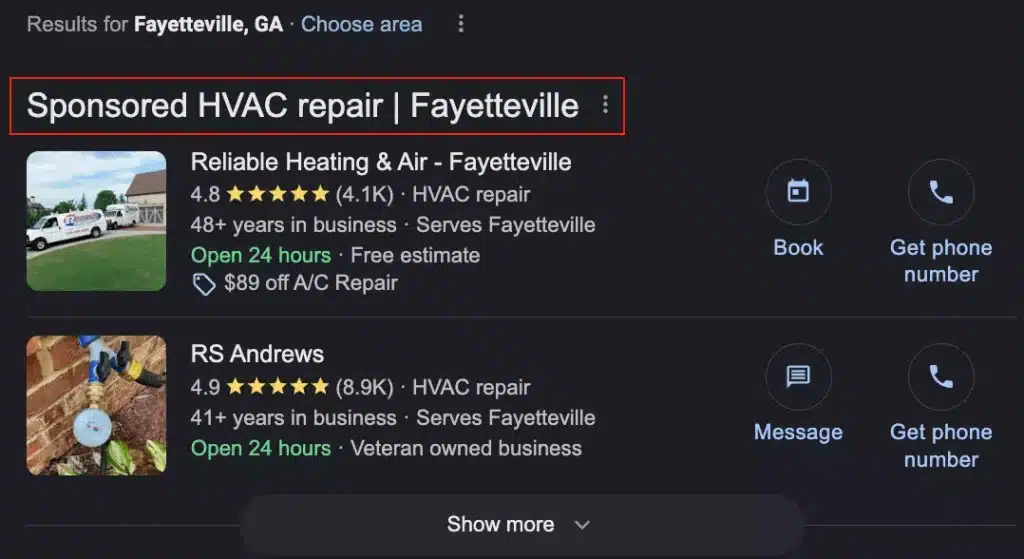
Local Service Ads (LSA) appear at the very top of Google search results for most emergency HVAC queries, and they feature each business’s review count and aggregate star rating.

Because HVAC issues require fast response, Google’s Local Service Ads (LSA) are especially valuable in this industry. However, LSA is also competitive and requires a rigorous screening process to become eligible.

HVAC companies must pass a background check, provide proof of licensing and insurance, and maintain a minimum review rating (typically 3.0).

Keep in mind that LSA uses a pay-per-lead model instead of the traditional pay-per-click, which means most local HVAC businesses pay between $25 and $100 per lead, depending on your market.


HVAC companies jumping into LSA tend to assume getting shown is about who pays the most. But Google considers more than ad spend in their LSA ranking algorithm.

For example, Google LSA really values response time, so the faster you respond to inquiries, the higher you can rank over time. Review velocity and recency are also heavily weighted factors, along with proximity.


Businesses with a CRM such as Housceall Pro or Jobber can integrate direct booking within their LSA ad, allowing customers to schedule a service directly from the ad.

It’s also beneficial to train dispatchers on response times, ensuring they prioritize fast response to maximize LSA visibility.


HVAC Local Service Ads from SERP

4) Social Media Advertising

HVAC social media ads can be effective, but they serve a much different purpose than LSA or SEO. Ads on social media are more about nurturing long-term trust than filling an immediate need.

Most of your target consumers scroll Facebook, Instagram, YouTube, and TikTok daily, but in most cases, they aren’t logging in to fill an immediate need, such as “my AC just broke.”

That said, social media ads are quite effective at filling the blind spots that Google Ads (including LSA) don’t cover.


An example of effective HVAC social media advertising is “shoulder season filler,” which runs ads for early-bird inspections and maintenance specials during lulls when leads are scarce.

Retargeting is another high-ROI social media advertising strategy that involves running social media ads to website visitors who’ve already shown interest in your services.

The most effective social ads are video-based and feature short clips of you or your staff speaking directly to your target consumers. These help build trust long-term and legitimize your brand.


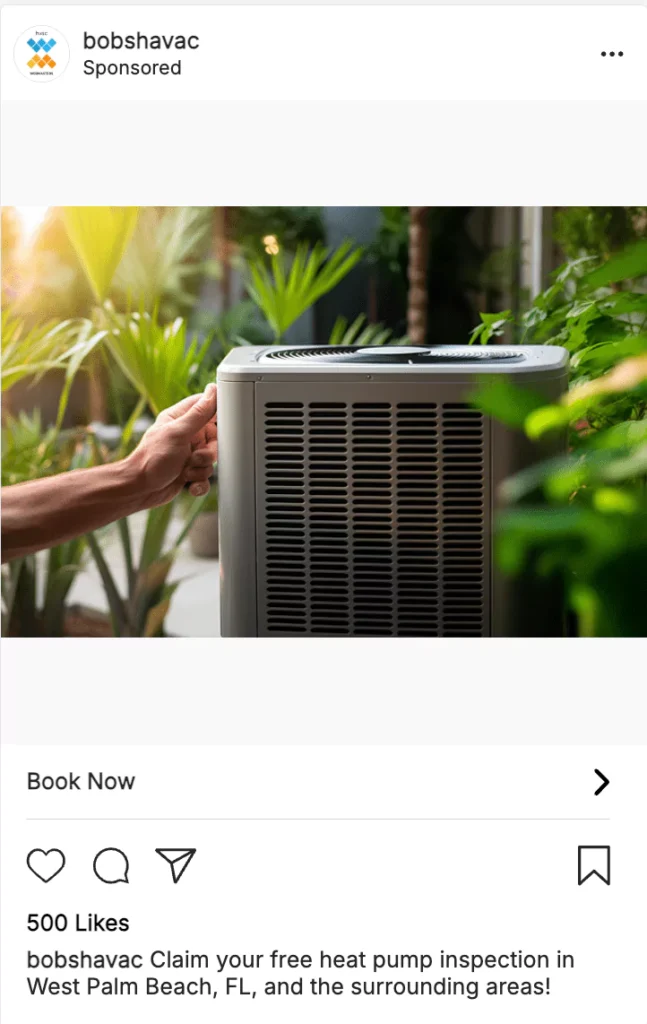
HVAC Instagram Ad Mockup

5) Local Pack Optimization

As a local HVAC company, you want your Google Business Profile (formerly known as Google My Business) to rank in Google’s local 3-pack.

While the aforementioned Local Service Ads (LSA) are normally at the very top of search results, those are “pay to play,” and the local pack results, which are often immediately below the LSA, are organic.

HVAC businesses that consistently rank in the local 3-pack for high-intent search queries can maximize their ROI because they don’t have to pay for these organic leads.


One key to ranking in the local 3-pack is to optimize your Google Business Profile with all relevant services.

You can choose a primary category of HVAC Contractor and secondary categories that include: Air Conditioning Repair Service, Furnace Repair Service, Air Conditioning Installation, and Heating Contractor.

You can then manually add more obscure services, such as Mini-Split AC Installation or Thermostat Repair, to help you show up for long-tail queries in your service areas.


In addition, don’t overlook the impact of your website on your local pack rankings. An optimized website can directly influence local pack rankings through website justifications.

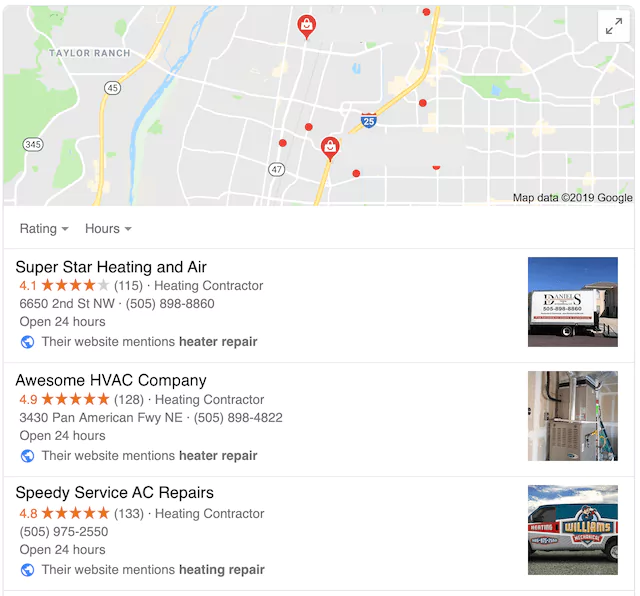
The local pack will publicly state, “Their website mentions (keyword)” when showing results for a specific query, highlighting how they pull content directly from the attached URL.


Screenshot of Google Maps 3-Pack Featuring HVAC Companies

6) E-E-A-T Website Signals

E-E-A-T stands for expertise, experience, authoritativeness, and trustworthiness, and is an acronym coined by Google to guide its search quality raters in evaluating websites and ranking systems.

Actively integrating E-E-A-T into your business website is a marketing effort on multiple fronts. First, it helps convert website visitors into customers. Secondly, it protects your website against future algorithm updates.

You can demonstrate these E-E-A-T qualities through various measures, including adding your licenses and awards to your website’s homepage and embedding a review plugin to display verified 3rd-party customer reviews.


HVAC EEAT Badges

7) Community Engagement & Sponsorships

Many small businesses operate under the “rule of 7,” a marketing theory that holds that a consumer must see your logo 7 times before trusting the brand.

Participation in local events and organizations helps your business build a positive association with your community.

As digital platforms like Google work to credit businesses that build authentic brands offline, these tasks become even more critical.


Sponsoring Little League teams is a great example. Seeing your business logo on your kids’ sports jerseys hits differently than seeing it on their Facebook app.

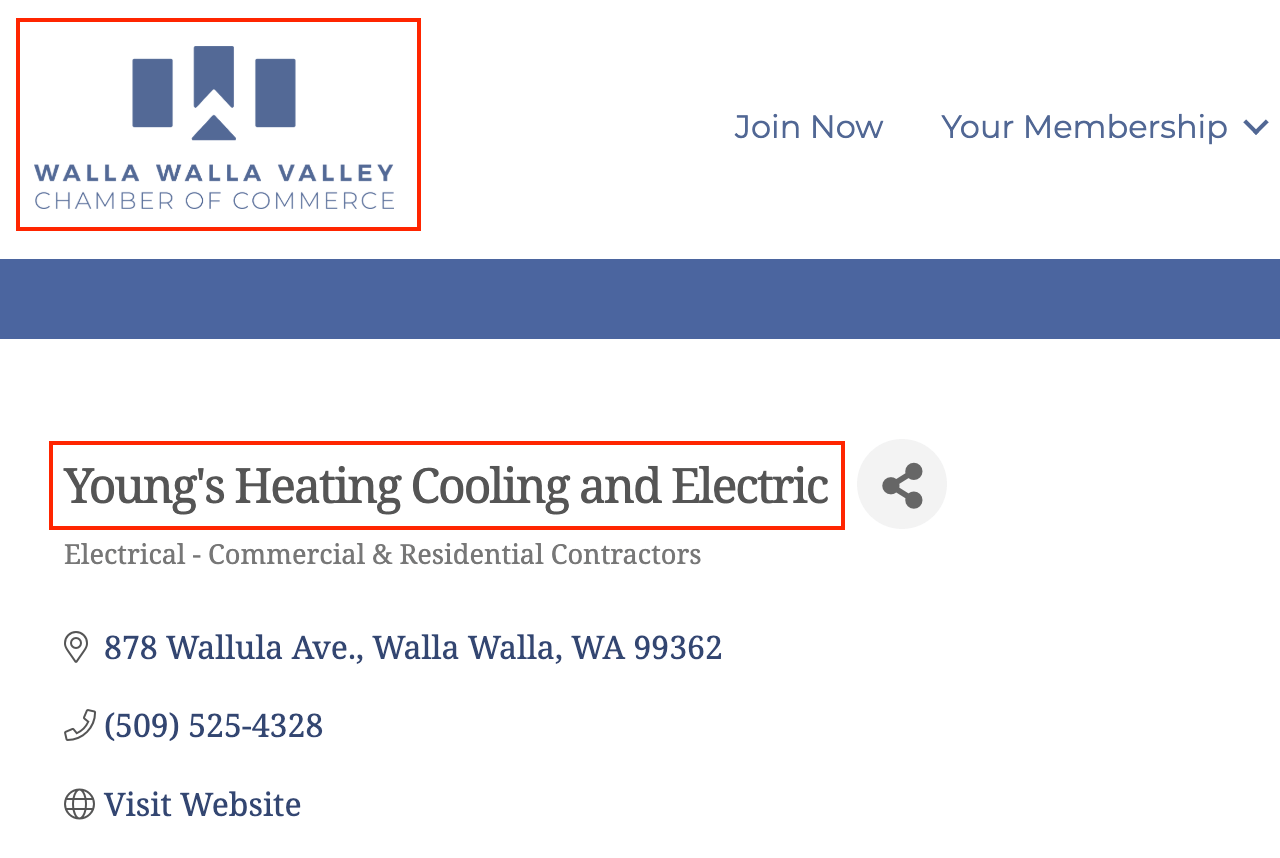
In addition, community sponsorships serve as backlink goldmines. Local organization websites typically have strong trust signals and local relevance, which improve local rankings.


Community Membership Example from Walla Walla, WA Chamber of Commerce

8) Email Marketing

Email marketing yields one of the highest ROIs for HVAC companies (between $36-40 made per $1 spent), but it serves a different purpose than SEO or LSA.

Implementing email marketing into your campaign is about maximizing lifetime value for existing customers, rather than acquiring new ones.

HVAC companies that grow consistently accumulate membership sign-ups, and emails are a great way to convert one-time repair customers into lifetime members.


Consistent email campaigns can also help companies land higher ticket jobs, such as full AC or furnace replacements, which are rooted more in trust than in an immediate need.

In this context, educational email drip campaigns help existing customers notice the warning signs of aging units while simultaneously building trust and goodwill.


Don’t forget the reputation management aspect of email marketing, as email review requests help increase the number of reviews on your Google Business Profile and other business listings.

Using email marketing software such as ActiveCampaign or AWeber, HVAC companies can track metrics like open rates, click-through rates, and unsubscribe rates in the dashboard. From there, companies can adjust their campaigns to increase success.


Screenshot of Email Marketing Graphic on AWeber

9) Truck Wraps

Truck wraps serve as mobile billboards that consistently reach your target audience, making them one of the top offline marketing assets for local HVAC companies.

An effective truck wrap design features your company logo, color scheme, phone number (with large, legible text), and other branding elements.

I recommend including a branded QR code (tracked with a UTM tag for conversion measurement) and website URL to expand your exposure to a digital interface.


HVAC Truck Wraps

10) Customer Referral Programs

The highest-conversion lead for heating and cooling businesses remains one of your existing customers recommending your business to a friend. The best way to increase these occurrences is through a customer referral program.

Referral programs lower your company’s customer acquisition cost (CAC) and help leverage your current customer base to expand your business.


The best way to structure a referral program is to base it on the type of referral. Service-based referrals can follow the $50-for-$50 model, in which the customer receives $50 for the referral, and the friend receives $50 off their initial service.

Higher-ticket services, such as system replacements, can follow a membership model, in which the referrer gets a 3-year maintenance membership.

One of the most effective ways to maximize participation in your program is to eliminate friction, such as laborious “log in” portals or sign-up processes. You want to keep things quick and simple.


11) Direct Mail & Print Advertising

Physical media has experienced a resurgence in HVAC marketing because it reaches blind spots that digital promotion cannot. For one thing, mailers and print ads convey trust and credibility more than digital ads do.

Secondly, print media presents some unique targeting options, such as “new homeowners” who have likely not selected their “go-to” HVAC technician.

Print media also offers a more predictable and consistent cost per lead, generally sitting in a range of between $90 and $115, while Google Ads may spike during peak seasons.


One of the advantages of modern print marketing is bridging the gap with digital. Include QR codes on your mailers so users can quickly access your website through their mobile devices.

You can then follow up with these leads through email sequences and retargeting campaigns, allowing your business to deploy all your marketing resources in a single campaign.


HVAC Postcard Example (Front)

How To Launch Your HVAC Marketing Campaign

HVAC marketing is not about being the “loudest” business; it’s about striking a balance between short-term visibility and long-term trust.

Presenting your company as an option for emergency situations, such as AC or furnace repairs, requires immediate visibility through LSA, SEO, and local pack rankings.

Meanwhile, your ability to transition customers from one-time repairs to long-term membership sign-ups is predicated on channels such as email marketing and social media retargeting.

The connective tissue of your marketing campaign lies in long-term trust-building, rooted in reputation management, community sponsorships, and branded truck wraps.

By strategically investing in this combination of marketing channels, your business can create the conditions for a stream of high-quality, high-intent HVAC leads.


Use these outlined strategies to start implementing your HVAC marketing campaign and building a strong foundation for present and future profitability.


Nolen Walker

Author: Nolen Walker

Nolen Walker is an SEO entrepreneur with over 16 years of first-hand experience helping HVAC companies grow through organic search, Google Maps, and AI-driven visibility. He is the founder of HVAC Webmasters and DataPins, a local SEO platform that showcases real HVAC jobs using geo-tagged media and structured data.

Nolen is the author of A Complete SEO Guide for the HVAC Small Business Owner and hosts The HVAC Marketing Plan Podcast and the Nolen Walker Podcast on Spotify.


  • plumbing heating and air alliance member
  • contractors of america best digital agency
  • expertise.com best seo agencies in fort worth

The Essential Local SEO Guide for HVAC Contractors


Throughout my career of crafting and executing Local SEO campaigns for professional HVAC companies, much has changed, from algorithm updates to shifts in consumer search behavior.

One thing that has remained constant is the value of appearing in search results for local queries like ‘HVAC company near me’.

I’m Nolen Walker, the founder and CEO of HVAC Webmasters. Based on my experience as an SEO agency owner, I’ve written the ultimate guide to Local SEO for HVAC companies.


Key Takeaway

HVAC companies can succeed with Local SEO by optimizing their Google Business Profiles, publishing location-specific website content, and building consistent, relevant citations across the web.


Local SEO for HVAC (Guide Cover)

Local SEO’s Impact on HVAC Companies

Local SEO for HVAC is the practice of optimizing your HVAC business for local searches on Google and other search engines.

Specifically, the practice targets Google Map 3-Pack rankings with your Google Business Profile and regionally-targeted landing pages for traditional organic results.

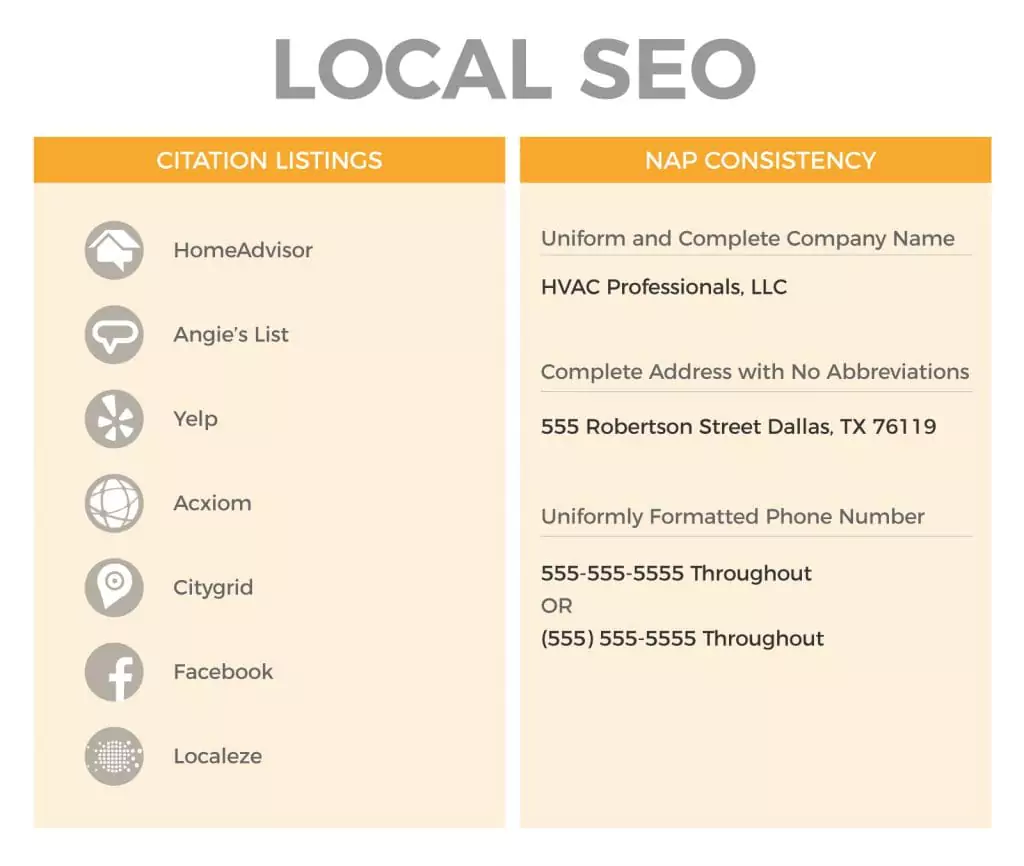
Local SEO encompasses various SEO practices, including NAP citations, Google Business Profile listings, and local website landing pages, all of which are essential for HVAC companies.


Local SEO Infographic

Why HVAC Companies Need Local SEO

Local SEO is tremendously important, given how potential clients typically search for your heating and air services (by location).

Over the past decade, my agency, HVAC Webmasters, has worked with thousands of contractors to achieve favorable local SERP results.


Check out some of my agency’s case studies to learn more.


Not only should your organic on-page and social media content include a focus on local keywords that rank well for geographic factors, but there are additional elements to local SEO that you can employ to help search engines like Google recognize where you are.

This is what ensures you’re prominently displayed in SERPs. Some of the local SEO elements that a strong internet marketing plan will include:


  • Citation Management
  • Google Business Profile management
  • E-E-A-T Signals
  • AI Crawlability
  • Embedded Google Maps on Contact Page
  • NAP Consistency
  • Review Management
  • Schema Markup

You don’t have to know how to execute these variables yourself to have a successful HVAC website.

However, you need to leverage experts in local SEO (like us) who can assemble all the pieces of the puzzle to make your site appear strong and logical when Google retrieves location-specific results for users.

Moz listed these (and several other factors) when considering local search ranking results, and some elements weigh more heavily than others when moving the dial on your SERP position.

Google Map 3-Packs appear at the top of SERPs for most local queries, such as hvac contractor near meac repair services near me, and other related phrases.


Local SEO Ranking Factors for HVAC

Once HVAC companies understand the importance of local ranking, they naturally wonder how to influence it.

Google Maps and Google Search rankings are based on separate algorithms, so each requires a unique solution. That said, some aspects of each algorithm are carried over to the other. 

Below, I will outline local SEO ranking factors based on first-hand experience with hundreds of HVAC companies. Mastering each factor gives your company the best chance to rank on both Google Search and Google Maps.


Though Google’s algorithm continuously evolves, it is vital to establish a baseline of best practices for consistent growth in your industry.


Google Business Profile

Claiming and optimizing your Google Business listing is crucial for local SEO. You can claim your business here and start ranking on the Local Map 3-Pack.

You should ensure your contact information is accurate, upload unique photos, and provide answers to the FAQ. You should also enter your website URL in the appropriate GBP field.

Google Business Profile serves as your local SEO foundation. Without a listing, ranking becomes implausible. Sometimes, HVAC companies have multiple listings, so it’s best to merge them.


You must also decide whether to list your address publicly, since most HVAC businesses are service-area businesses (SABs).

Your GBP listing will also serve as a central hub for your Google Reviews, which we will discuss below.

You can share your review link, email signature, and other promotional content in your marketing materials.

Google Business Profile reviews have the greatest impact on Google Maps rankings and increase GBP conversions.


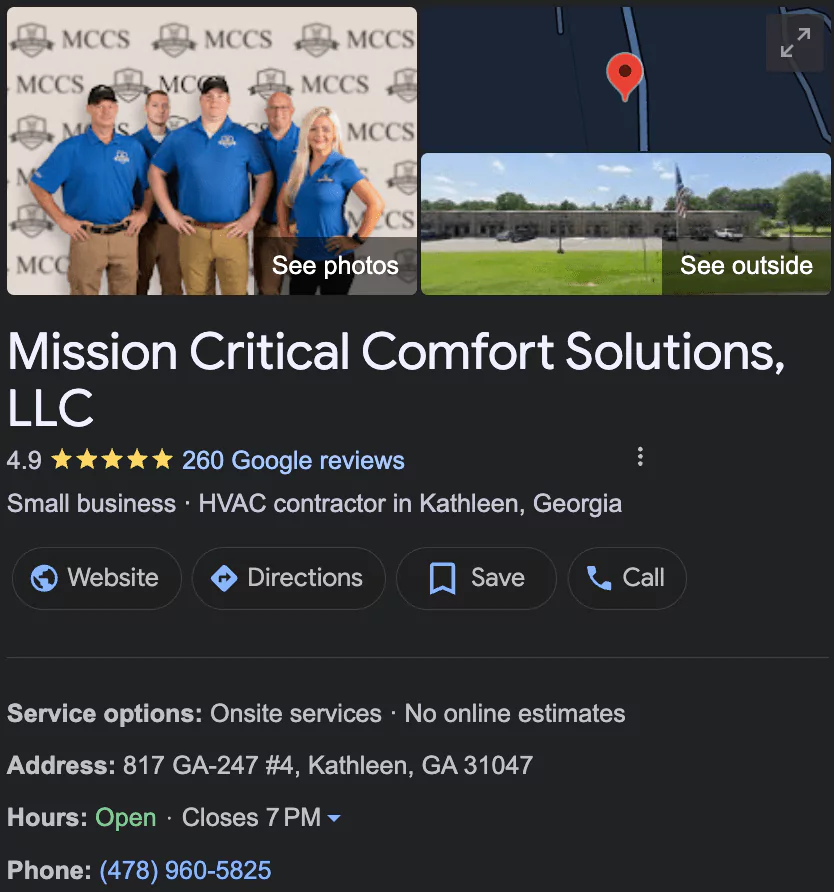
HVAC GMB Listing Example

Google Reviews

Generating Google Reviews is crucial to the local SEO success of HVAC companies. Google makes it easy to share your review form by providing a shortlink you can share with customers.

Still, HVAC companies often overlook the importance of staying on top of the review generation process. Investing in a local SEO tool, such as DataPins, solves the problem for good.

DataPins sends automated review requests to customers after finishing jobs. When customers leave Google Reviews, your company gains more credibility and converts more prospects.


In addition to requesting reviews, DataPins also empowers contractors to perform jobsite check-ins.

If you provide enough service, customers may eventually leave negative reviews. A few negative reviews won’t hurt your business, but responding to each review makes sense.

If they decide to return and use your company, try to address their concerns and provide excellent service. Remember that prospects are watching how you react to every review.


DataPins

The DataPins tool does more than increase review request conversions. The app also helps HVAC companies rank for more keywords on Google Maps and the Google Map 3-Pack.

One of the most significant ranking factors on Google’s Map 3-Pack is the content on the associated website.

Each Google Business Profile includes a field for the business to enter its website URL. When that website features DataPins, it powers the entire Google Business Profile.


The Map 3-Pack algorithm can now detect the various services you offer (via DataPins captions) and the areas where you performed the jobs.

Third-party studies have confirmed that nearly 50% of all search queries are undetectable, with a significant portion of those being long-tail keywords.

For example, a string of words like american standard air conditioner repair service in hershey pennsylvania is not something you can find on keyword research tools. Still, it represents the type of query that drives visitors to your Google Business Profile.


NAP Citations

The terms “NAP” and “Citations” are often used interchangeably; however, to understand them as critical elements for local SEO, it is best to examine what they represent: Name, Address, and Phone (NAP).

It’s a no-brainer that potential customers searching for local HVAC businesses via Google will want easily accessible contact information.

Especially if the issue is emergent—such as a broken furnace in the middle of winter—a viewer needs to be able to find your phone number in seconds to schedule a repair!


NAP data is vital for user experience, demonstrates to Google that your site is well-developed and valuable, and explicitly communicates contact information.

This makes you an excellent fit for searches that match your stated service area (determined by location keywords or the address listed), which means Google and other search engines will give your site higher rankings to meet that need.

NAP is crucial to your primary HVAC website’s SEO, including on-page content, a thoughtfully designed Contact Page, structured data, and your secondary websites. 


Consider social media business pages, Google Business Profiles, and directory listing pages, among others, which serve as citations for your HVAC business.

All of these potential entry points are opportunities to provide a great user experience by ensuring NAP consistency, optimizing pages, and managing citations across the web.

This establishes authority and reliability regarding your overall web presence, significantly boosting your local SEO.


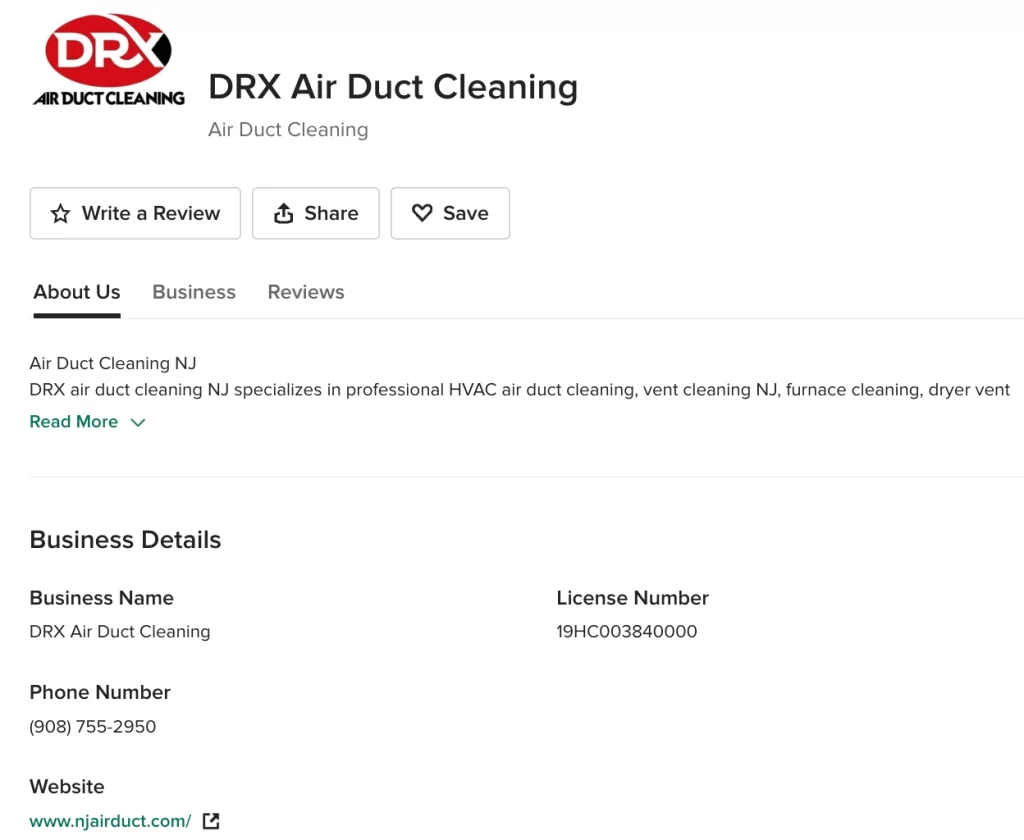
Houzz Citation Example

Local SEO Content

Organic content has a significant, long-term impact on your ability to rank well for local SEO. For Localized Organic Ranking Factors, the on-page signals count for 26% of your ranking score.

What does this mean? It’s (hopefully) no surprise at this point that you need high-quality copywriting on your website.

You can’t put a single paragraph on a webpage about HVAC services and expect that to inform your potential customers in any meaningful way, nor will it reward you with a top spot on the search engine results page.


I will go ahead and hammer this point home: Google wants what your site visitors want

When potential customers click through to your website from the results page or a citation page, they expect to find relevant information. There is no value if you have generic or lackluster content, or if your content volume is minimal.

You’re not adding anything worth reviewing; thus, you aren’t considered an optimal candidate for Google to serve up in the rankings.


We understand that high-quality content is crucial for HVAC businesses, but incorporating location-specific keywords into the content can have a significant impact on local SEO.

It’s one thing to kick butt for the keyword search “best heating company,” but if the user follows suit with typical behavior, they’re going to tack on their city name or zip code to get more tailored results.

In fact, Google often prompts users to add “near me” or even their city (based on location services). You will not seem relevant if you haven’t optimized your service area (or areas).

Using strong H1 tags with the city name, along with high-performing search keywords, will help your site make significant improvements.


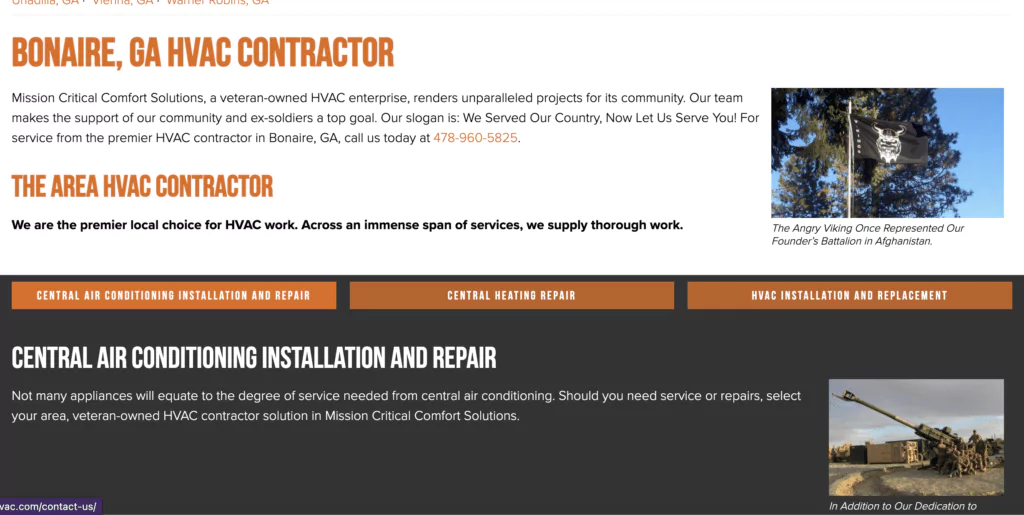
Local HVAC Landing Page

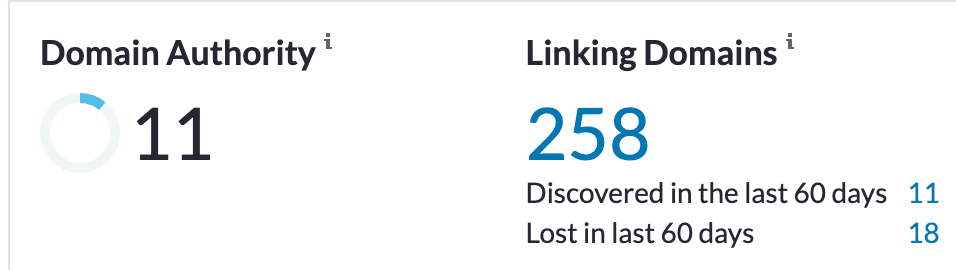
Domain Authority

Another factor to consider is Domain Authority. In a nutshell, MOZ’s domain authority metric is a 1-100 ranking that helps gauge your site’s strength relative to other trusted domains based on links.

This means establishing outgoing links to reputable organizations (such as unions, trade organizations, and libraries) and incoming links that validate your content as traffic-worthy. 

This doesn’t mean you should engage in shady linkback tactics. Instead, it reinforces an organic SEO strategy that acknowledges good content, providing value to the internet and its users, as the linchpin of an effective internet marketing campaign.

Receiving links from nearby organizations can bolster your local reputation and cultivate relationships.


Domain Authority Score

User Experience

User experience influences your local rankings, as Google’s primary objective is to provide users with a seamless experience that helps them achieve their goals.

A slow-loading website with poor navigation and a complex mobile layout discourages users from taking action, such as filling out a contact form or clicking a phone number.

As a result, Google will demote this website in favor of a competitor that offers a better user experience.

Content and information must be good, accessible, and accurate, and you must also ensure that all typical user experience elements are intact.


This includes:


  • Engaging Design
  • Intuitive Site Navigation
  • Obvious “Call to Action” Buttons
  • Optimized Image Size For Device
  • Prompt Page Loading

A strong website UX contributes to local rankings, just as SEO does. Click-to-call buttons are especially helpful to local consumers.


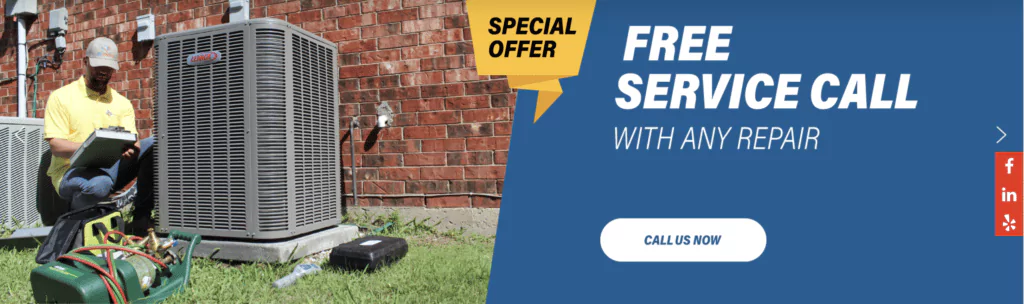
Special Offer on HVAC Website

Local Keyword Optimization

Local keyword optimization is similar to traditional SEO, but it focuses on local terms and phrases.

Company websites should still follow standard optimization protocols, as best practices remain valid when crafting a local keyword strategy.

My agency, HVAC Webmasters, is a leader in online marketing for heating and cooling companies. I’ve worked with contractors in this industry for decades and know what it takes to market effectively to their core audience.


Local keyword optimization consists of the following:


  • Body Content: Distribution of local terms throughout the body text
  • Meta Descriptions: Inclusion of local phrases within web page meta descriptions
  • Title / Header Tags: Placement of local keywords within title and header tags
  • URL Slugs: Disposal of local terms within URL slugs

With WordPress, website managers can easily manage title and header tags, body content, and URL slugs. Internal linking is another tactic that emphasizes HVAC keywords.

Link to your most important pages from other internal pages, and use the anchor text to include the relevant keyword. Of course, ensure that your terms make sense to the reader and avoid spammy keyword placement.

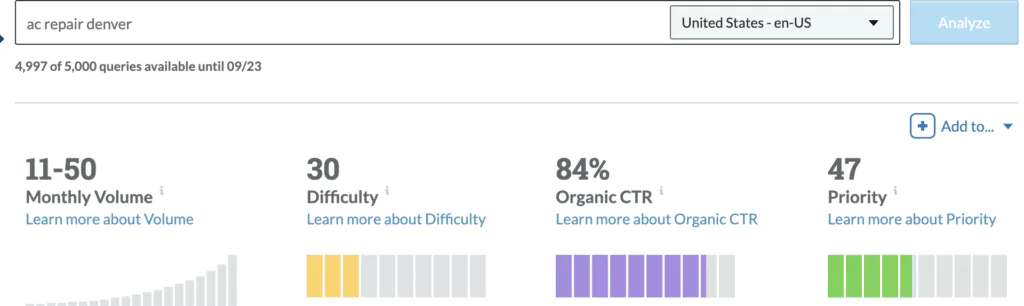
Keyword research for local SEO can yield lower search volumes with lower difficulties. Remember that many local queries don’t register volume on research tools, but they still drive traffic to your website and GBP.


AC Repair Denver Keyword Research MOZ

E-E-A-T

Experience, expertise, authoritativeness, and trustworthiness are characteristics that Google looks for in local HVAC websites.

These principles are becoming increasingly important due to Google AI Overviews and AI Mode, as well as the December 2025 Core Update.

HVAC websites can demonstrate E-E-A-T in various ways, including an informative “About Us” page, an embedded review slider featuring verified feedback from Google Business Profile, Yelp, and other trusted sources, and showcases of recent jobs (such as pins and check-ins from DataPins).


Check out each letter of the acronym below:


  • Experience: Demonstrate hands-on experience with HVAC services
  • Expertise: Convey expert status related to the HVAC industry
  • Authoritativeness: Earn endorsements (links, mentions, etc.) from other credible sources
  • Trustworthiness: Accumulate and showcase customer feedback, primarily through reviews

E-E-A-T extends beyond your website; it also examines your relationship with other digital entities, such as your Google Business Profile or Facebook Business page.

As a result, it’s essential to invest in a comprehensive branding strategy for your digital presence.


How AI Impacts Local SEO for HVAC Companies

AI platforms such as Google AI Mode also influence local SEO in the modern search landscape.

Google’s AI Mode looks for many of the same signals as their traditional algorithm, including Google Business Profile optimization, Google reviews, and E-E-A-T signals.


The two additional points of emphasis for ranking in Google AI on the local level include:


  • AI Crawlability
  • Query-Fan Out Optimization

AI Crawlability

For your website to be referenced in AI-generated responses, Google Gemini must be able to crawl and access your website without being blocked or throttled.

Some HVAC businesses are unaware that their CDN, such as Cloudflare, blocks AI bots from crawling their websites by default.

Ensure that your agency or the person handling your local SEO campaign updates these settings to make your website accessible to AI crawls.


Query-Fan Out Optimization

Google AI Overviews and AI Mode use a concept called query fan-out, where they search for multiple queries simultaneously and then synthesize the results of each query to provide a citation.

In layman’s terms, your target pages must rank for multiple long-tail queries rather than just the primary keyword.

The more relevant keywords your page or post ranks for, the more likely you are to show up in AI-generated results.


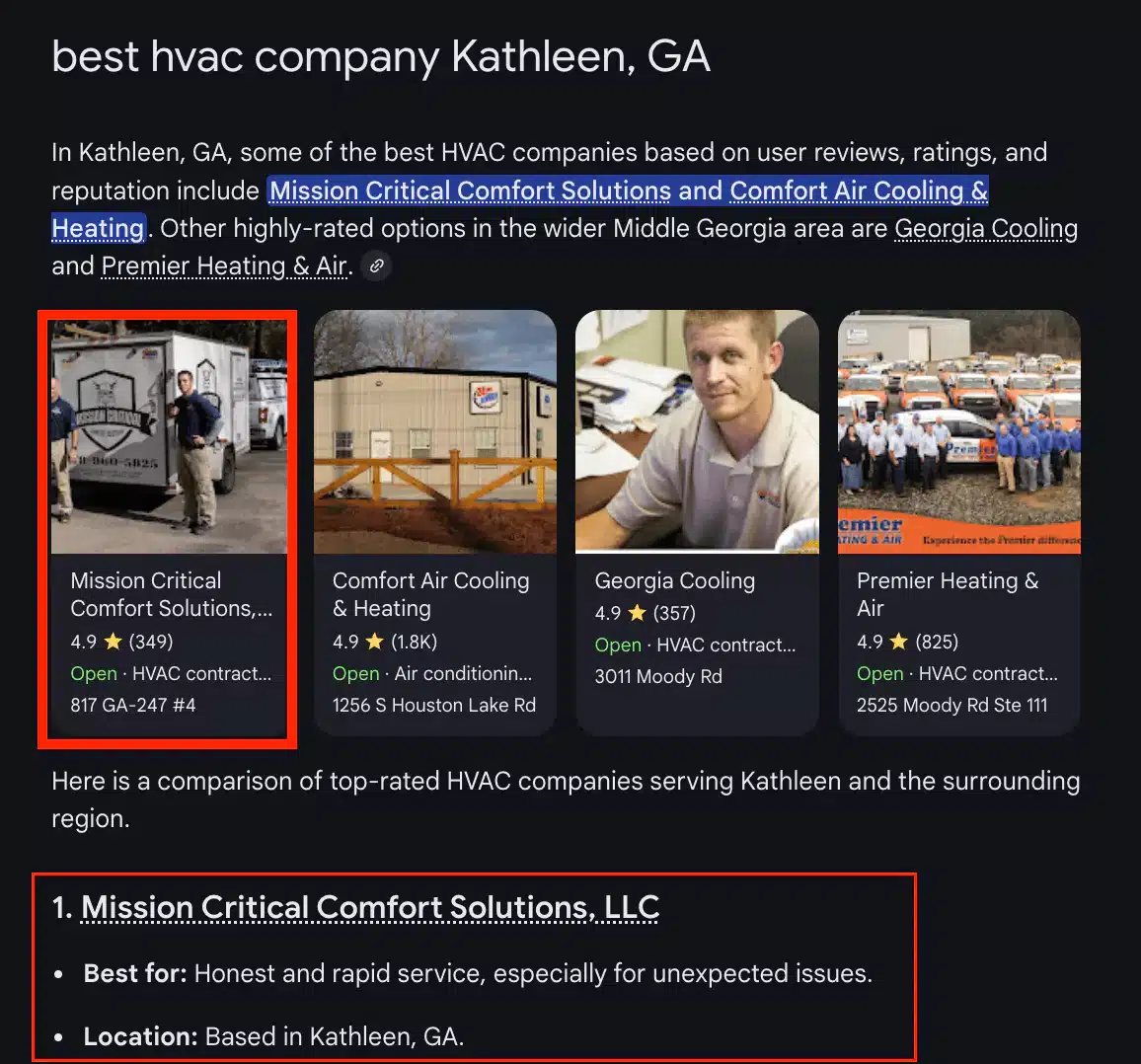
Local HVAC Company Appearing in Google AI Mode Results

Making The Most of Local SEO for HVAC Companies

Local SEO is crucial to your HVAC company’s online presence. Most of your target consumers will search for queries like “ac repair near me” and view the Local Map 3-Pack results. As a result, it’s vital that your listing appears within the pack.

The techniques above, including citations, GBP optimization, review generation, and DataPins, are each essential to ensuring local map rankings.


Beware of misinformation regarding local search optimization for HVAC contractors. Ensure your sources have experience and expertise.

For example, I’ve provided digital marketing services to heating and cooling companies for over a decade at my agency, HVAC Webmasters.

My entire process is dedicated to helping you rank for local terms on Google and other search engines.


Nolen Walker

Author: Nolen Walker

Nolen Walker is an SEO entrepreneur with over 16 years of first-hand experience helping HVAC companies grow through organic search, Google Maps, and AI-driven visibility. He is the founder of HVAC Webmasters and DataPins , a local SEO platform that showcases real HVAC jobs using geo-tagged media and structured data.

Nolen is the author of A Complete SEO Guide for the HVAC Small Business Owner and hosts The HVAC Marketing Plan Podcast and the Nolen Walker Podcast on Spotify .


  • plumbing heating and air alliance member
  • contractors of america best digital agency
  • expertise.com best seo agencies in fort worth

9 (Amazing) HVAC Social Media Posts Ideas


More than 80% of U.S. adults use some form of social media, but HVAC companies often lack the time to brainstorm social media posts. As a business owner or operator, this can be a frustrating problem.

Google is no longer the only place homeowners look for HVAC services, making social media platforms an increasingly integral part of your broader digital marketing strategy.

As the owner of HVAC Webmasters, my digital marketing agency has helped companies across the United States refine their social media strategy and increase their visibility on social platforms.


If you’re looking for ideas for your Facebook, X, Instagram, YouTube, or Google Posts, this article outlines concepts proven to drive engagement for HVAC company social profiles.

Below, I will outline nine practical social media post ideas for heating and cooling companies.


Blog Cover for HVAC Social Media Posts

1) Company Culture Post

One of the most effective social media posts for HVAC contractors demonstrates company culture. Highlighting your company’s principles, such as loyalty, honor, and respect, can go a long way toward connecting with customers.

For example, business owners with military backgrounds can integrate their background into company culture, setting expectations for employees and holding one another accountable.

A company’s culture extends beyond the internal operation. It also helps establish your business’s consumer perception, which is why social media is an outstanding way to showcase it to prospective customers.


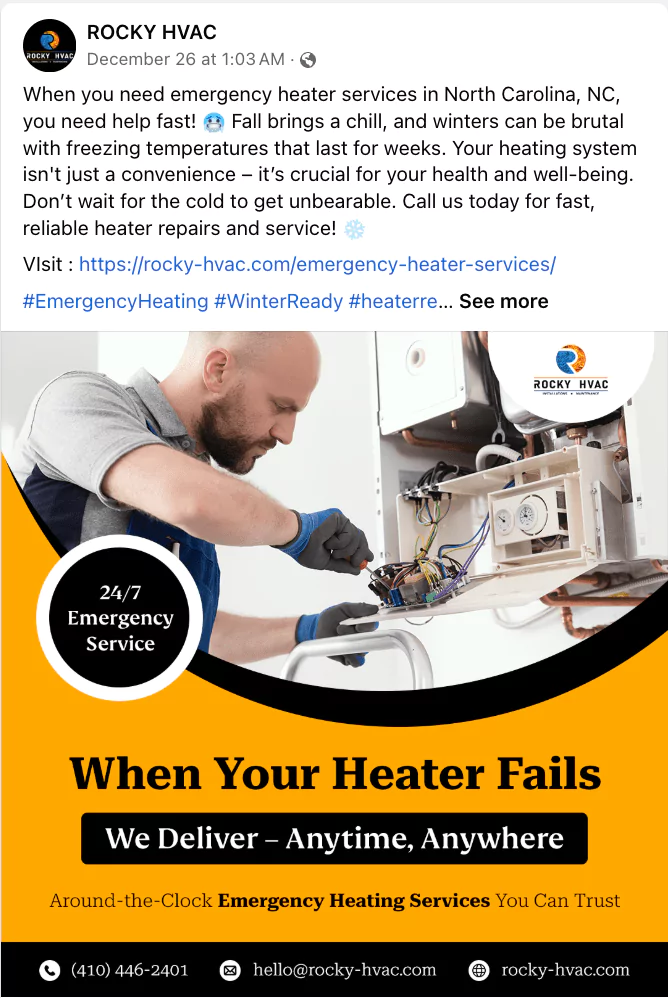
Example Social Media Post Highlighting Company Culture

2) Repurposed Content Post

If you are familiar with content marketing, you understand that one piece of content can be used in various ways. A great example of this is repurposing a high-engagement blog post into a social media video reel.

Repurposing content across multiple platforms maximizes the ROI of each piece, whether it’s a comprehensive, data-driven blog post or a 45-minute podcast.

There’s one caveat to repurposing blog content: thin, low-quality blog posts don’t translate to high-engagement video reels. Choose engaging, high-quality posts with appealing blog topics to benefit both your website and social media profiles.


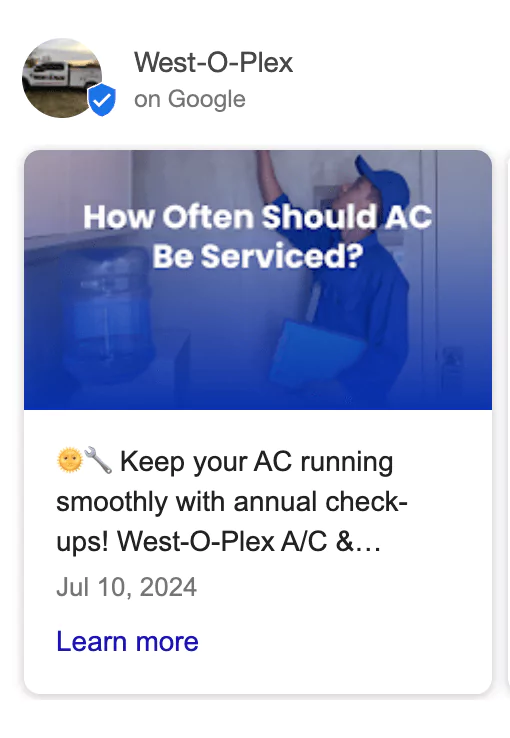
Google Post Showcasing Blog Style Article

3) Seasonal Post

When it comes to social media marketing for HVAC companies, seasonal weather changes can be a significant inspiration. After all, your consumers’ needs change with the seasons.

For example, emerging winter weather calls for furnace maintenance, heating repair, and other services to keep residents warm. It also introduces a social media theme that drives built-in engagement.

When your social posts resonate with your target consumers, they form a more favorable perception of your company and brand. These posts show empathy towards consumers’ current pain points.


Social Media Post Example Showing Seasonal Theme

4) Holiday Post

Like with seasons, holiday posts are a great source of inspiration for HVAC social media as they align with cross-industry themes and speak directly to consumers’ expectations.

Whether it’s Christmas, Thanksgiving, Halloween, or Memorial Day, your company can share the holiday spirit with followers, something that works across any industry but especially heating and cooling.

HVAC contractors also often run promos during these periods, which you can integrate into your social media post theme to drive conversions directly on Instagram, Facebook, and other platforms.


Social Media Post Showing Memorial Day Tribute

5) Service-Based Post

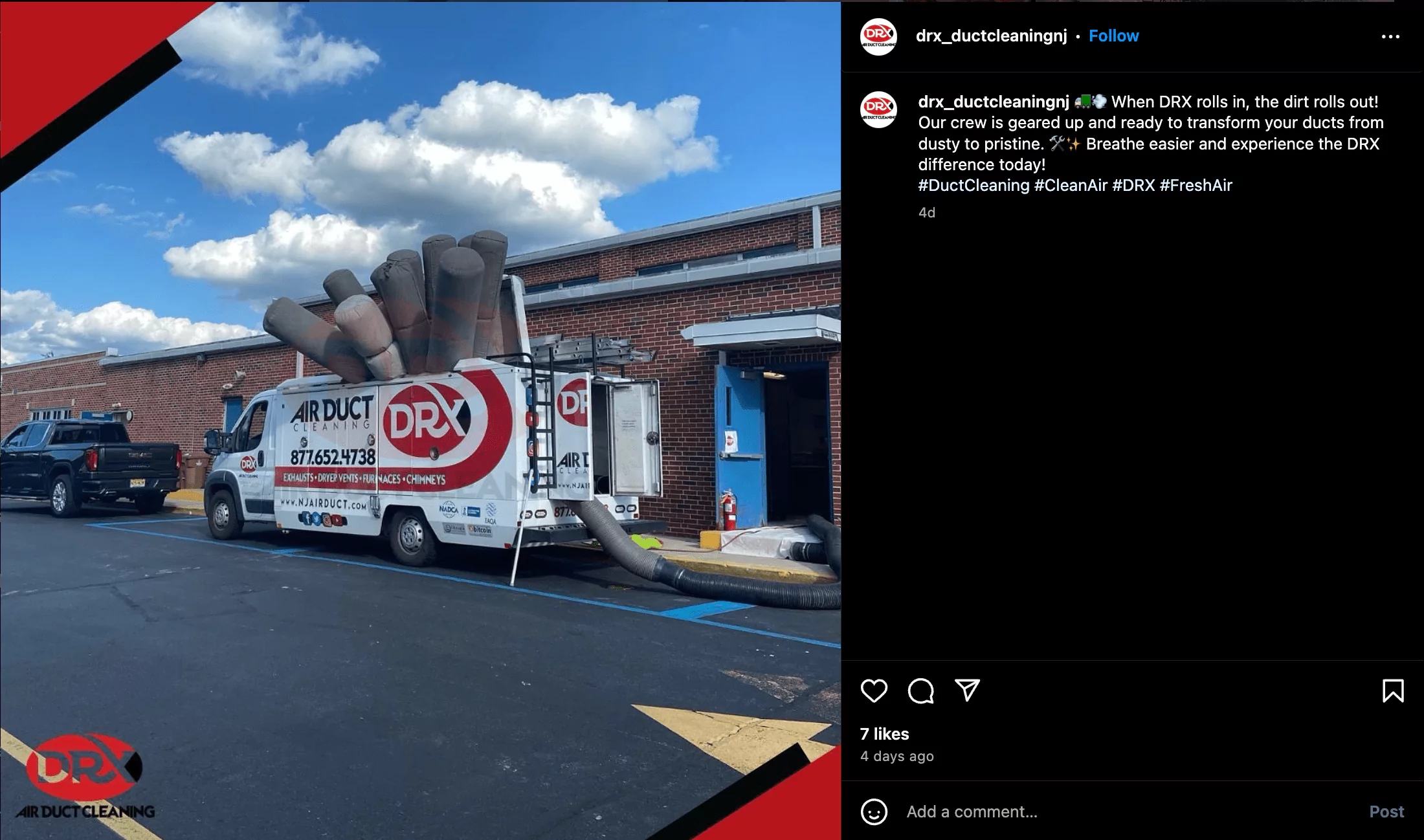
Highlighting a featured service can help draw interest from social media followers and help reinforce your brand’s association with key service offerings.

AI platforms, such as ChatGPT, use web content to associate business entities with service entities, making service-based social posts beneficial beyond their on-platform engagement metrics.

If your company offers a rare or unique type of service, be sure to highlight it in your social post. One example is mini-split AC system services, which one of our clients used to generate 3.8 leads per month, well above the average for a Google post.


Social Media Post Showing Featured Service Type

6) Social Proof Post

At its core, social media is about community and bringing people together. There’s no better way to spark interaction than by providing social proof, which means demonstrating evidence of your success.

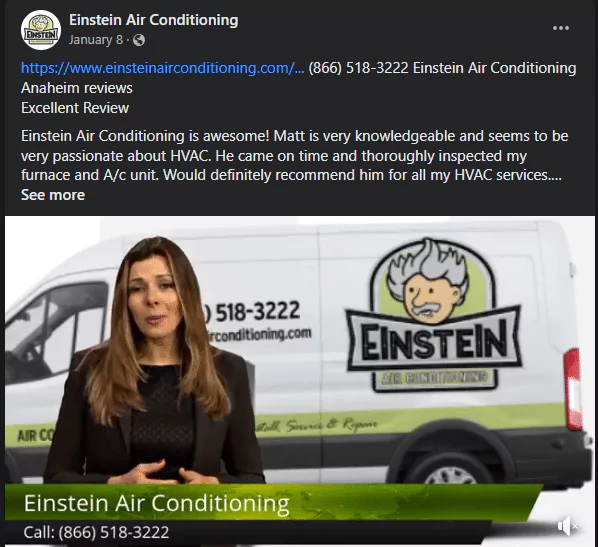
For example, creating a social media post highlighting a recent customer review is a great way to foster engagement and increase conversions for your AC and heating service. 

Most prospective customers buy based on trust and credibility, which is precisely what social proof posts help establish for your business.


Social Post Showcasing Customer Review

7) Jobsite Post

Social media followers respond more favorably when they see you in action. That’s why images or videos of your team performing an on-site job as an AC company can multiply impressions compared to generic posts.

Nothing builds credibility more than real-time images and videos, which give onlookers an inside peek at your services. Showing yourself and your staff is also a great way to personalize your brand.

You can use a software tool like DataPins to post jobsite content across multiple platforms from your website to social media, including Facebook, YouTube, and Instagram.


Social Media Post Example Showing Company Owner At Job Site

8) Blooper Reels Post

Comedy content performs well on social media, whether it’s TikTok, YouTube Shorts, or Instagram Reels.

Don’t let being a professional heating and cooling contractor keep you from leveraging this brand of content; any business, including yours, can share things like a blooper reel or outtakes.

Most HVAC businesses have that one technician who makes everyone laugh, a trait that will resonate with your social media followers.


Blooper Reels Social Media Post Example

9) Before-and-After Posts

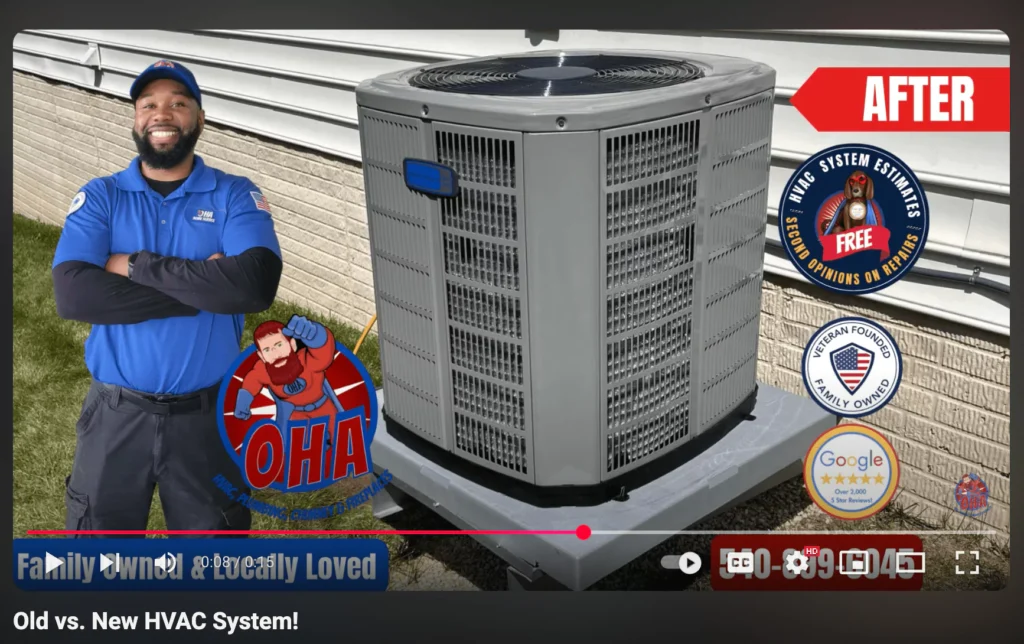
Much like jobsite posts, before-and-after social media posts give consumers more confidence in your services by providing visual evidence of your expertise.

Several of my agency’s clients rely on this post style to increase conversions by providing visual evidence, helping prospective customers envision the completed service.

These before-and-after style social posts can appear on platforms like Facebook, Instagram, and YouTube, and can also be included within Google search results for certain HVAC-related queries.


Before-and-After Social Media Post Example for HVAC Company

Where To Publish Social Media Posts for HVAC

Now that you have some excellent ideas of what content to post, you must decide where to publish it. Naturally, the best platforms are the ones where you’ve already built a significant following.

The one exception is Google Posts, which can appear anytime a user searches for your brand name. Below is a list of social media platforms that are optimal for posting.


Facebook

Facebook’s organic reach is limited, so you will need to boost posts to reach a significant audience. Think of a boosted post as a post/advertisement.

Although you are paying for others to see it, like with a Facebook ad, it appears post-form and tends to reach people organically.


Google Posts

Google is an excellent platform for posting social media content, as users will see it every time they search for your brand name.

Unlike social networks like Facebook and Instagram, users don’t need to follow your company to see your posts on their search engine.

Of course, you will need to claim your Google Business Profile before posting anything.


Instagram

Instagram, owned by Facebook/Meta, is the best platform for posting visual-driven social media content.

For example, images or short videos of your on-site work will appeal to Instagram followers. Unlike Facebook, IG allows users to see your content without boosting the post.


X

X can be hit-or-miss for HVAC companies, but occasionally posting on your feed is worthwhile. Unfortunately, most HVAC consumers are not using X to engage with companies.

Still, establishing a profile and posting your content lends credibility to your business. Also, be sure to include your contact information within your profile.


YouTube

While some hesitate to categorize YouTube as “social media,” it’s clear that HVAC content performs well on YouTube and can expand into Google search results.

Since Google’s parent company owns YouTube, you should think of the content on this platform as an extension of your broader Google brand.

Furthermore, posting YouTube Shorts is much like posting on Facebook and Instagram Reels, as users will watch these short-form videos for hours.


TikTok

Americans spend over 54 hours per month on TikTok, which means posting video content on this platform virtually guarantees impressions.

While their core user base skews younger than the target HVAC service consumer, the value of brand exposure should not be underestimated.

As more searchers adopt AI platforms to identify the top-rated heating and cooling companies, investing in an omnichannel, multimodal approach is both wise and proactive.


Moving Forward with HVAC Social Media Posts

The rise in social media popularity can create an overwhelming feeling for small HVAC businesses that are trying to compete in their local markets.

Don’t let fear deter you, as any business can create effective social media posts that enhance your brand and online visibility.

Utilize the HVAC social media post ideas in this article to inspire action. Remember, you don’t have to post perfect content to get noticed online.


Nolen Walker

Author: Nolen Walker

Nolen Walker is an SEO entrepreneur with over 16 years of first-hand experience helping HVAC companies grow through organic search, Google Maps, and AI-driven visibility. He is the founder of HVAC Webmasters and DataPins , a local SEO platform that showcases real HVAC jobs using geo-tagged media and structured data.

Nolen is the author of A Complete SEO Guide for the HVAC Small Business Owner and hosts The HVAC Marketing Plan Podcast and the Nolen Walker Podcast on Spotify .


  • plumbing heating and air alliance member
  • contractors of america best digital agency
  • expertise.com best seo agencies in fort worth

The HVAC Google Maps Guide (for Higher Rankings)


Because HVAC is a high-intent, location-based service, homeowners with AC or furnace problems rarely scroll past Google Maps, specifically the initial Local Map 3-Pack.

At HVAC Webmasters, we’ve researched Google Maps optimization for more than a decade, and while the algorithm continues to evolve, the demand for reputable, fast-responding heating and cooling services remains strong.

The following guide outlines the benefits of Google Maps visibility for HVAC companies, along with strategies and techniques to help maximize its impact on your broader digital marketing campaign.


Google Maps for HVAC (Guide Cover)

How Google Maps Drives HVAC Lead Generation

Appearing in the Local Map 3-Pack for high-intent queries like “AC repair near me” is one of the most effective and affordable lead generation methods.

Although some HVAC companies consider Local Service Ads (LSA) a more predictable lead channel, they can expect to pay $45-$85 per lead and sometimes more than $100 per lead in major metros.

Conversely, a local HVAC company that ranks highly on Google Maps receives higher-conversion calls and inquiries without paying for a lead or a click.


Getting Listed on Google Maps

HVAC companies without a listing must claim and verify their Google Business Profile (GPB), which will serve as the engine that powers Google Maps and Local 3-Pack visibility.

The verification process for new listings is extremely stringent and typically requires video verification. The video must be submitted through the Google Business Profile mobile app as a continuous, unedited 30-90-second video.

Companies with a storefront must show the surrounding area, such as neighboring businesses and street signs, along with permanent signage, access to staff-only areas, and evidence of tools, business cards, licenses, and other documentation.

Most HVAC companies are service-area businesses (SABs), meaning they operate out of their homes. In this case, you must mark your business as an SAB (which publicly hides your address) and select a service area for the markets you travel to.

SABs must still submit a video verification showing items such as their wrapped work truck, tools, documents, and business cards.


How Your Website Impacts Google Maps

Your Google Business Profile should include your business website URL, which directly impacts your Google Maps rankings.

A well-optimized business website empowers your Google Business Profile to appear in the Local Map 3-Pack for various services and keywords, often displayed on your listing as “website justifications.”

Including service pages for each one of your HVAC offerings is a powerful way to expand your keyword coverage on Google Maps results.


Screenshot of Google Maps 3-Pack Featuring HVAC Companies

Google Maps Ranking Factors

Google Maps rankings are based on three factors: distance, relevance, and prominence. These pillars determine which listings secure the top 3 positions in Google’s coveted Local 3-Pack.


Let’s take a closer look at each factor:


Distance (Proximity)

The distance of your verified address to the searcher’s location is a local ranking factor. Google uses mobile GPS data to approximate the searcher’s location.

Businesses with a storefront tend to perform better in Google Maps results than companies listed as a Service Area Business (SAB).

However, SABs are still subject to the distance ranking factor as Google still uses your address (though publicly hidden) to approximate the distance from the searcher’s estimated location.


Relevance

Relevance measures how closely your business listing relates to the searcher’s query.

While keywords in your business name still help, Google also scans your primary category (e.g., Air Conditioning Contractor), your service list, and the keywords mentioned in your reviews.

HVAC companies often make the mistake of inserting keywords into their business name even though their business registration does not match. This often results in a suspension, which removes your listing from the search results.


Prominence

Prominence is a measure of your company’s digital reputation both on Google Maps and across the web.

Google uses signals from external sources (like credible links and brand mentions) to help determine a business’s prominence.

Reviews are also a factor, especially review velocity (the recency and frequency of your reviews). Getting 3-5 reviews per week can help your listing gain and maintain top Google Maps rankings.


Google Maps Optimization for HVAC Businesses

While some Google Maps ranking factors are outside of your control as a business owner, there are steps you can take to optimize your business listing for increased Google Maps visibility.

Below, I will outline my recommended Google Maps optimization strategies for HVAC professionals.


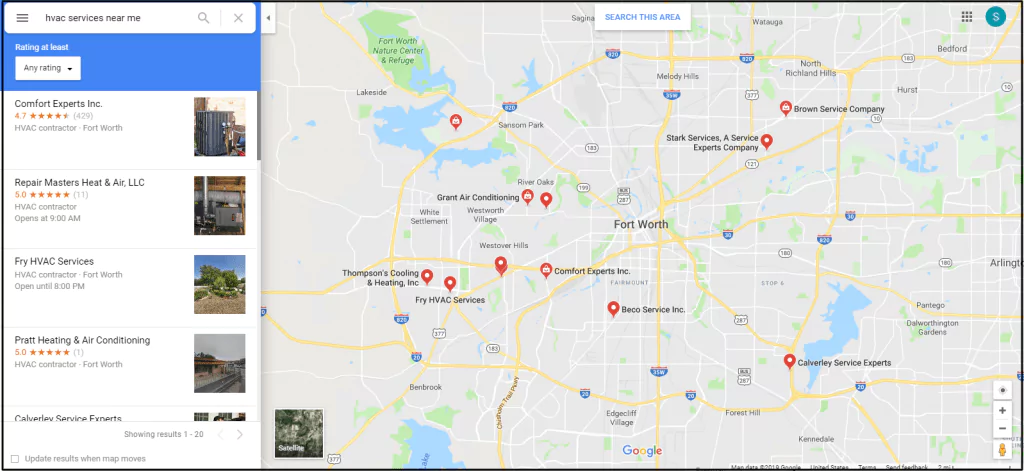
Screenshot of Google Maps Search Results Within Maps Interface

Business Address

Your business address directly impacts the “distance” ranking factor based on the searcher’s location, whether you’re listed as a service area business (SAB) or have a storefront.

If your business is not generating any leads through Google Maps, you might consider moving to a different office location. Keep in mind, this will likely trigger reverification and require you to submit a video proving your business and location are authentic.

When searching for office space, you’ll want to target a location near the center of your primary city or perhaps move to another nearby city with a larger population.


Website URL

The most undervalued aspect of Google Maps rankings is your connected website URL. Google scans your connected website for information and keywords, which they can then display as “website justifications.”

Optimizing your website, including adding individual service pages, can help you show up on Google Maps for more keywords.

If your website mentions services like AC coil repair or Lennox gas furnace repair, Google Maps can scan these various terms and phrases, providing a better context for ranking the associated business listing.


Google Reviews

Google Reviews impact your rankings on Google Maps. While there’s no shortcut to getting legitimate customer reviews, you can accelerate the process with automated requests via text and email.

Most reputation management software and contractor CRMs provide a review request feature, so it can become part of your standard business operation.

Review velocity has a greater impact on visibility than total reviews. Google prefers a consistent stream of 3-5 reviews per week rather than a sudden spike of 50 reviews, followed by zero subsequent activity.


NAP Citations

Citations on directories like Angi, BBB, and Yelp can help establish the prominence of your Google Business Profile.

Displaying consistent information across the web (name, address, and phone number) on trusted sources helps authenticate your business.

You can build these citations manually, or you can use a service like Whitespark to build these on your behalf.

One thing to keep in mind is that citations only influence the algorithm when they’re indexed by Google. So obscure citations on spammy directories aren’t going to move the needle.

However, mentions in HVAC-specific directories, such as AHRI or Carrier/Lennox dealer locators, can carry substantial topical weight and positively influence visibility.


Google Posts

Google Posts are like the social media feed for your business profile. While they don’t directly influence your rankings, they can impact your click-through rate and conversion velocity.

Much like your website content, Google Posts can also prompt a Search Justification when they match the topic or intent of the user’s query.

Posts tend to have a short shelf-life, so I recommend creating one post per week, each featuring a call-to-action (CTA) such as “Call Now” or “Book”.

Because HVAC is a highly seasonal service, matching your posts to the user’s current needs (depending on your climate) is an effective way to maintain relevance year-round.

If you are unsure how to create a Google Post, follow this guide. You’ll find the process simple and something you can do within minutes.


Ranking Outside Your Main Service Area

One of the most common questions among HVAC business owners is, “I’m based in Frisco, so why don’t I show up on the Local Map 3-Pack in Dallas?”

The uncomfortable truth is that Google Maps is primarily designed for storefronts and prioritizes the user’s proximity, which is inherently in conflict with how an HVAC company operates (driving to multiple service areas to perform work)

So the next question becomes,” Is there anything I can do to rank in nearby neighboring cities?”


Ranking in Nearby Cities on Google Maps

HVAC companies CAN rank in nearby cities on Google Maps and the Local Map 3-Pack. However, in most cases, this happens in smaller cities with lower populations.

If Google has fewer businesses to choose from in a specific area, they are more likely to expand further from the searcher’s location to show a listing that meets all of the other criteria (reviews, relevance, etc.)

Optimizing your listing and its connected website, and getting consistent reviews, are the best ways to expand your visibility in neighboring cities on Google Maps.


Ranking in Nearby Cities on Traditional Organic Results

The easiest way to rank in nearby cities is in traditional organic results. You can achieve these through dedicated location pages or by populating your service pages with job-site check-ins (schema snippets outlining your jobs in nearby areas).

HVAC companies (or their marketing agencies) tend to abuse the “location page” strategy by creating hundreds or thousands of near-duplicate pages, which clearly violates Google’s spam policies, as reinforced in their most recent core update.

I recommend the check-ins strategy because it adds trust and credibility to your website while showing visitors legitimate proof of your recent jobs.


Next Steps for Google Maps Optimization

Google Maps and the Local Map 3-Pack are coveted positions for local HVAC companies. As we’ve outlined, organic leads empower business owners to consistently gain customers without paying the $45-$85 per lead (on average) in Local Service Ads.

Ranking in Google Maps is based on relevance, distance, and prominence, and HVAC companies can take tangible steps to increase their visibility. For one, choosing an office location in a high-population area provides a strong foundation for future success.

Connecting your optimized business website URL to your Google Business Profile is another significant lever to pull. When you create high-quality pages for each HVAC service, your GBP can rank for a broader range of queries, which can be displayed as Website Justifications.

And don’t forget about your reviews, not just the total amount, but the velocity. Make sure you have an automated system in place to send text and email review requests to your customers, with a goal of getting 3-5 new reviews per week.

For further assistance with your Google Maps optimization process, contact us today for a free consultation.


Nolen Walker

Author: Nolen Walker

Nolen Walker is the founder of HVAC Webmasters and the creator of DataPins™, a Local SEO platform for HVAC companies. He has over 16 years of experience helping HVAC businesses grow through organic search, Google Maps, and AI-driven visibility.

Nolen is the author of A Complete SEO Guide for the HVAC Small Business Owner . He also hosts The HVAC Marketing Plan Podcast and The Nolen Walker Podcast on Spotify.