
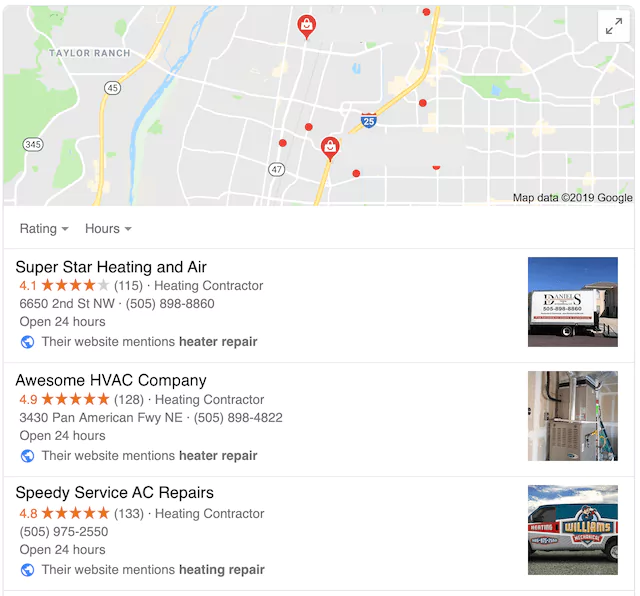
Because HVAC is a high-intent, location-based service, homeowners with AC or furnace problems rarely scroll past Google Maps, specifically the initial Local Map 3-Pack.
At HVAC Webmasters, we’ve researched Google Maps optimization for more than a decade, and while the algorithm continues to evolve, the demand for reputable, fast-responding heating and cooling services remains strong.
The following guide outlines the benefits of Google Maps visibility for HVAC companies, along with strategies and techniques to help maximize its impact on your broader digital marketing campaign.
How Google Maps Drives HVAC Lead Generation
Appearing in the Local Map 3-Pack for high-intent queries like “AC repair near me” is one of the most effective and affordable lead generation methods.
Although some HVAC companies consider Local Service Ads (LSA) a more predictable lead channel, they can expect to pay $45-$85 per lead and sometimes more than $100 per lead in major metros.
Conversely, a local HVAC company that ranks highly on Google Maps receives higher-conversion calls and inquiries without paying for a lead or a click.
Getting Listed on Google Maps
HVAC companies without a listing must claim and verify their Google Business Profile (GPB), which will serve as the engine that powers Google Maps and Local 3-Pack visibility.
The verification process for new listings is extremely stringent and typically requires video verification. The video must be submitted through the Google Business Profile mobile app as a continuous, unedited 30-90-second video.
Companies with a storefront must show the surrounding area, such as neighboring businesses and street signs, along with permanent signage, access to staff-only areas, and evidence of tools, business cards, licenses, and other documentation.
Most HVAC companies are service-area businesses (SABs), meaning they operate out of their homes. In this case, you must mark your business as an SAB (which publicly hides your address) and select a service area for the markets you travel to.
SABs must still submit a video verification showing items such as their wrapped work truck, tools, documents, and business cards.
How Your Website Impacts Google Maps
Your Google Business Profile should include your business website URL, which directly impacts your Google Maps rankings.
A well-optimized business website empowers your Google Business Profile to appear in the Local Map 3-Pack for various services and keywords, often displayed on your listing as “website justifications.”
Including service pages for each one of your HVAC offerings is a powerful way to expand your keyword coverage on Google Maps results.
Google Maps Ranking Factors
Google Maps rankings are based on three factors: distance, relevance, and prominence. These pillars determine which listings secure the top 3 positions in Google’s coveted Local 3-Pack.
Let’s take a closer look at each factor:
Distance (Proximity)
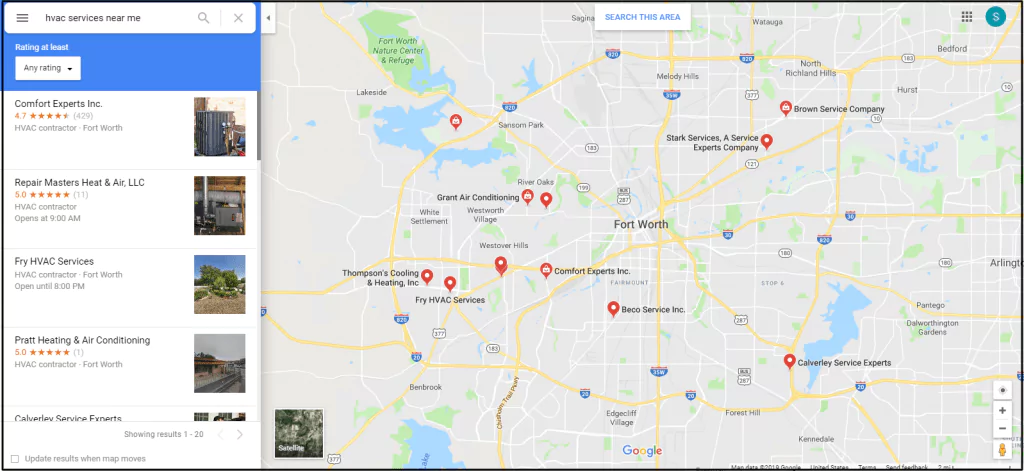
The distance of your verified address to the searcher’s location is a local ranking factor. Google uses mobile GPS data to approximate the searcher’s location.
Businesses with a storefront tend to perform better in Google Maps results than companies listed as a Service Area Business (SAB).
However, SABs are still subject to the distance ranking factor as Google still uses your address (though publicly hidden) to approximate the distance from the searcher’s estimated location.
Relevance
Relevance measures how closely your business listing relates to the searcher’s query.
While keywords in your business name still help, Google also scans your primary category (e.g., Air Conditioning Contractor), your service list, and the keywords mentioned in your reviews.
HVAC companies often make the mistake of inserting keywords into their business name even though their business registration does not match. This often results in a suspension, which removes your listing from the search results.
Prominence
Prominence is a measure of your company’s digital reputation both on Google Maps and across the web.
Google uses signals from external sources (like credible links and brand mentions) to help determine a business’s prominence.
Reviews are also a factor, especially review velocity (the recency and frequency of your reviews). Getting 3-5 reviews per week can help your listing gain and maintain top Google Maps rankings.
Google Maps Optimization for HVAC Businesses
While some Google Maps ranking factors are outside of your control as a business owner, there are steps you can take to optimize your business listing for increased Google Maps visibility.
Below, I will outline my recommended Google Maps optimization strategies for HVAC professionals.
Business Address
Your business address directly impacts the “distance” ranking factor based on the searcher’s location, whether you’re listed as a service area business (SAB) or have a storefront.
If your business is not generating any leads through Google Maps, you might consider moving to a different office location. Keep in mind, this will likely trigger reverification and require you to submit a video proving your business and location are authentic.
When searching for office space, you’ll want to target a location near the center of your primary city or perhaps move to another nearby city with a larger population.
Website URL
The most undervalued aspect of Google Maps rankings is your connected website URL. Google scans your connected website for information and keywords, which they can then display as “website justifications.”
Optimizing your website, including adding individual service pages, can help you show up on Google Maps for more keywords.
If your website mentions services like AC coil repair or Lennox gas furnace repair, Google Maps can scan these various terms and phrases, providing a better context for ranking the associated business listing.
Google Reviews
Google Reviews impact your rankings on Google Maps. While there’s no shortcut to getting legitimate customer reviews, you can accelerate the process with automated requests via text and email.
Most reputation management software and contractor CRMs provide a review request feature, so it can become part of your standard business operation.
Review velocity has a greater impact on visibility than total reviews. Google prefers a consistent stream of 3-5 reviews per week rather than a sudden spike of 50 reviews, followed by zero subsequent activity.
NAP Citations
Citations on directories like Angi, BBB, and Yelp can help establish the prominence of your Google Business Profile.
Displaying consistent information across the web (name, address, and phone number) on trusted sources helps authenticate your business.
You can build these citations manually, or you can use a service like Whitespark to build these on your behalf.
One thing to keep in mind is that citations only influence the algorithm when they’re indexed by Google. So obscure citations on spammy directories aren’t going to move the needle.
However, mentions in HVAC-specific directories, such as AHRI or Carrier/Lennox dealer locators, can carry substantial topical weight and positively influence visibility.
Google Posts
Google Posts are like the social media feed for your business profile. While they don’t directly influence your rankings, they can impact your click-through rate and conversion velocity.
Much like your website content, Google Posts can also prompt a Search Justification when they match the topic or intent of the user’s query.
Posts tend to have a short shelf-life, so I recommend creating one post per week, each featuring a call-to-action (CTA) such as “Call Now” or “Book”.
Because HVAC is a highly seasonal service, matching your posts to the user’s current needs (depending on your climate) is an effective way to maintain relevance year-round.
If you are unsure how to create a Google Post, follow this guide. You’ll find the process simple and something you can do within minutes.
Ranking Outside Your Main Service Area
One of the most common questions among HVAC business owners is, “I’m based in Frisco, so why don’t I show up on the Local Map 3-Pack in Dallas?”
The uncomfortable truth is that Google Maps is primarily designed for storefronts and prioritizes the user’s proximity, which is inherently in conflict with how an HVAC company operates (driving to multiple service areas to perform work)
So the next question becomes,” Is there anything I can do to rank in nearby neighboring cities?”
Ranking in Nearby Cities on Google Maps
HVAC companies CAN rank in nearby cities on Google Maps and the Local Map 3-Pack. However, in most cases, this happens in smaller cities with lower populations.
If Google has fewer businesses to choose from in a specific area, they are more likely to expand further from the searcher’s location to show a listing that meets all of the other criteria (reviews, relevance, etc.)
Optimizing your listing and its connected website, and getting consistent reviews, are the best ways to expand your visibility in neighboring cities on Google Maps.
Ranking in Nearby Cities on Traditional Organic Results
The easiest way to rank in nearby cities is in traditional organic results. You can achieve these through dedicated location pages or by populating your service pages with job-site check-ins (schema snippets outlining your jobs in nearby areas).
HVAC companies (or their marketing agencies) tend to abuse the “location page” strategy by creating hundreds or thousands of near-duplicate pages, which clearly violates Google’s spam policies, as reinforced in their most recent core update.
I recommend the check-ins strategy because it adds trust and credibility to your website while showing visitors legitimate proof of your recent jobs.
Next Steps for Google Maps Optimization
Google Maps and the Local Map 3-Pack are coveted positions for local HVAC companies. As we’ve outlined, organic leads empower business owners to consistently gain customers without paying the $45-$85 per lead (on average) in Local Service Ads.
Ranking in Google Maps is based on relevance, distance, and prominence, and HVAC companies can take tangible steps to increase their visibility. For one, choosing an office location in a high-population area provides a strong foundation for future success.
Connecting your optimized business website URL to your Google Business Profile is another significant lever to pull. When you create high-quality pages for each HVAC service, your GBP can rank for a broader range of queries, which can be displayed as Website Justifications.
And don’t forget about your reviews, not just the total amount, but the velocity. Make sure you have an automated system in place to send text and email review requests to your customers, with a goal of getting 3-5 new reviews per week.
For further assistance with your Google Maps optimization process, contact us today for a free consultation.

Author: Nolen Walker
Nolen Walker is the founder of HVAC Webmasters and the creator of DataPins™, a Local SEO platform for HVAC companies. He has over 16 years of experience helping HVAC businesses grow through organic search, Google Maps, and AI-driven visibility.
Nolen is the author of
A Complete SEO Guide for the HVAC Small Business Owner
.
He also hosts
The HVAC Marketing Plan Podcast
and
The Nolen Walker Podcast
on Spotify.