
While SEO still technically means search engine optimization, a more appropriate framing of the acronym today is search everywhere optimization.
Today, HVAC companies’ visibility goals extend beyond the “ten blue links” on Google search to multiple other platforms, including AI platforms such as Gemini, ChatGPT, and Claude, as well as social media platforms like Instagram, Facebook, and YouTube.
When I launched HVAC Webmasters – my SEO agency for HVAC Contractors more than a decade ago, I could not have predicted the industry’s current state.
Industry-altering technological advancements (such as AI) and algorithmic efficiency (e.g., Google Core Updates) have upended the traditional understanding of search engine optimization.
This comprehensive guide to SEO for HVAC companies outlines the best modern practices to increase online visibility for heating and cooling contractors on Google, AI, social media, and beyond.

How HVAC SEO Changed
SEO has changed significantly over the past five years, from shifts in consumer behavior to the emergence of artificial intelligence.
In May 2026, Google announced the largest single overhaul of its search interface in over 25 years. The search bar itself, once a simple text field, is now a Gemini 3.5 Flash-powered AI interface that accepts long, conversational queries and returns AI-generated summaries, visual data, and direct task completions.
Google has been clear that AEO (Answer Engine Optimization) is the same as optimizing for the search experience, and thus still SEO. However, Gemini, AI Overviews, and AI Mode are not the only places HVAC customers are searching.
Platforms like ChatGPT, Claude, Grok, Perplexity, and others have a growing monthly active user count, diversifying the methods homeowners use to research and identify qualified HVAC providers in their areas.
Here are the primary ways that search has evolved:
- AI: Google Gemini, OpenAI’s ChatGPT, and other AI platforms have fundamentally changed SEO.
- Algorithm updates: Examples include the Helpful Content and March Core Updates, which have altered the SEO landscape.
- Search Evaluator Guidelines: EEAT: experience, expertise, authority, and trustworthiness.
- Search Behavior: Fewer people are following the traditional search query-website-click-conversion path, as they increasingly perform zero-click searches and brand-awareness research across multiple platforms.
While Google’s algorithm still values factors like content quality, link authority, and on-page optimization, the standards for legitimizing your website and its content have risen considerably.
Today, HVAC sites that appear consistently across platforms are well-written, provide a good user experience, and offer unique information that is prominently visible across search platforms.
An “SEO-friendly website” in the modern search era includes schema markup, precise metadata, images, videos, and other media that align with the topic.

Why SEO Remains Important for HVAC Contractors
When someone in your area needs a product or service, they still use web platforms such as Google, ChatGPT, or even Reddit to research and identify providers.
If a consumer is seeking AC companies in Dallas, TX (which they may articulate in increasingly varied ways, ranging from keywords to full-on conversational prompts), lists of companies, relevant content, and information will appear in some form.
With AI, that will likely include specific HVAC companies mentioned in the AI-generated response.
With Google Search or Google Maps, you will see a list of businesses with links to their websites or Google Business Profiles.
Applying effective SEO tactics will help your company be among those mentioned or listed. Prominent search visibility leads to more inquiries, appointments, and business awareness for your HVAC company.
Agentic Search and HVAC Visibility
Google’s May 2026 search overhaul introduced information agents, which are persistent, user-created monitoring tasks that continuously scan the web and send alerts when specific criteria are met.
For HVAC contractors, the implications are immediate. A homeowner could create an agent that monitors for “licensed HVAC contractors in Scottsdale with availability for same-day AC repair and at least 4.5 stars.”
When Google’s agent finds matches, it surfaces them directly to that homeowner without a search query ever being submitted.
This shifts visibility from a reactive model (a homeowner searches, you appear) to a proactive one (an agent is always running, and your brand either qualifies or it doesn’t).
The contractors who surface in agentic results will be those with accurate, up-to-date Google Business Profiles, strong review velocity across multiple platforms, and verified job documentation that gives Google’s AI enough confidence to cite them by name.
SEO Strategy: The Planning Stage
Your SEO strategy should not be done on the fly or without extensive preparation. Effective SEO is well planned and grounded in research.
While your SEO plan should include well-researched keywords, it’s also essential to understand the limitations of “keywords” in modern SEO.
Traditional keyword research tools like SEMrush and Moz still provide useful competitive data, but their search volume metrics increasingly fail to capture how people actually query Google.
With the new expanded search bar designed for full-sentence, conversational queries, a homeowner in Wilmington is more likely to type “my central air stopped blowing cold air, and it’s 95 degrees outside, who can fix it today” than “AC repair Wilmington.”
Your pages need to answer real diagnostic questions, not just match keyword strings.
With this in mind, you’ll want to map specific user intents to service pages, such as homeowners looking for AC repair, furnace repair, indoor air quality testing, thermostat replacement, and more.
Understanding which services are frequently searched for helps you map out your service pages. However, the precise query or prompt the user ultimately uses will vary significantly.
National Keywords
High-volume keywords like HVAC Repair, Air Conditioner Installation, and Heating Services are delivered based on searchers’ locations, so local businesses aren’t competing with nationwide contractors for these terms.
While national directories such as Yelp still often appear in search results for local queries, it’s only because they have location-specific pages that list the “best companies” in that area.
You can typically outrank these Yelp lists by ensuring your website and its service pages feature enough authentic local context to build authority in your service area.
Identifying these top terms will also help when considering more specific longtail and service-related terms that pinpoint even more relevant searches.
Top keywords like these should be the primary keywords on your service pages to be indexed effectively and help SERP ranking.
Local Keywords
Local queries typically include a location identifier, such as the city name, after the primary keyword.
For instance, if you’re an HVAC company in Wilmington, DE, local homeowners may search for traditional terms like “AC Repair Wilmington” or “Wilmington Central Air Installation.”
On AI Mode, they may use more conversational queries such as “Please list the top-rated HVAC companies in Wilmington, DE, based on reviews and years in business.”
Depending on the size of your target city, there may not be a high search volume for keywords that include such location identifiers. However, this doesn’t mean nobody is searching for them.
Service Keywords
Although the primary HVAC services fall under the umbrella of national keywords and often register significant search volume on SEMRush, other lesser-known services may not register such volume.
Still, like with local keywords, these are valuable terms to rank for and will generate clicks and conversions.
Services like walk-in freezer repair and mini-split AC system installation are worth dedicated pages, even if they don’t have official search volume.
It’s also important to reiterate that more users now use conversational queries, meaning the verbatim keyword matters far less than establishing your company as an entity tied to the specific service and your target location.
URL Structure & Page Hierarchy
Once you compile your list of target keywords, you can set up your URL structure and page hierarchy.
Typically, sites have multiple pages that present information from a general to a more specific level. The organization of those pages is called the site or page structure.
Top Level Pages
Most HVAC websites have a top-level Home page, an About Us page, a Contact Us page, and a Reviews page. They may also have a few top-level general service pages, such as “Heating” or “Air Conditioning.”
These pages are typically included in your homepage’s main navigation menu, making it easy for search engine crawlers to access and index them quickly.
Example: https://yourhvaccompany.com/about-us
Second Level Pages
From there, HVAC sites lead to secondary pages that may include categories for specific HVAC services, such as “Central A/C Service,” “Furnace Service,” or “Central Heating.”
These URLs are nested under a parent category, such as Heating or Air Conditioning, and usually link back to that page internally.
Example: https://yourhvaccompany.com/heating/furnace-repair
Third Level Pages
The third level of pages branches into subcategories that address niche services such as “Natural Gas Furnace Repair” and “Ductless A/C System Installation.”
Your third-level pages must have plenty of internal links from the higher-level pages so that search engine crawlers can find them.
Example: https://yourhvaccompany.com/heating/furnace-repair/natural-gas/
Hierarchy Optimization
Your site structure should be straightforward and help Google index your pages for search rankings. The pages should flow nicely into each other and create a natural flow process for reaching them.
You should carefully consider the URL structure and your HVAC site’s page hierarchy. It is critical to map out each URL so you don’t create redundant content that covers the same service or category.
The URLs should be concise, presenting the exact topic and a clear path to the information.
Images & Videos
Younger homeowners spend their time on predominantly visual platforms like Instagram, TikTok, and YouTube, which increases the importance of visual media within your SEO strategy.
Google introduced an “Ask YouTube” feature for conversational AI video search at Google I/O 2026, making YouTube video content even more directly integrated into AI search.
HVAC websites should select original photos and videos during the planning stage to properly emphasize the content and prevent duplicate use.
In addition to your website and each of its pages, your Google Business Profile Images should also be unique and reflect your business, staff, and services.
Search Engine Optimization: The Implementation Stage
Once you have finished your SEO plan, you should have a clear layout of your site’s page structure along with keywords, images, videos, and URLs.
Even with a perfectly crafted plan, the ultimate success of your SEO strategy depends on implementation.
In this part of the process, you will need the assistance of a website designer, preferably one with experience in the HVAC marketing industry.
Custom Design
While multiple usable templates are available for your HVAC site, a custom website design is always best regarding SEO and searchability.
Templates lack the differentiation needed for your brand to stand out. A customized site design is best suited for implementing schema, flexibility, and CTA optimization.
Experienced HVAC web designers understand where to place calls to action to drive on-site conversions.
Contact Information
A lack of easy-to-access contact information is among the most significant contributors to low conversion rates.
Your HVAC site should have contact information listed on every page, including a location address and map, a phone number, and an email address.
Your company’s phone number should also appear throughout the content for maximum usability.
Call To Action
Any marketer worth their salt will tell you that a call to action is crucial.
Your page’s call to action leads, instructs, and inspires your site’s visitors to complete the desired action, whether to schedule an appointment or call for more information.
Your calls to action should be easy to find and conveniently located on the page to maximize usability and task completion (sometimes called goal completion).
Website Personalization
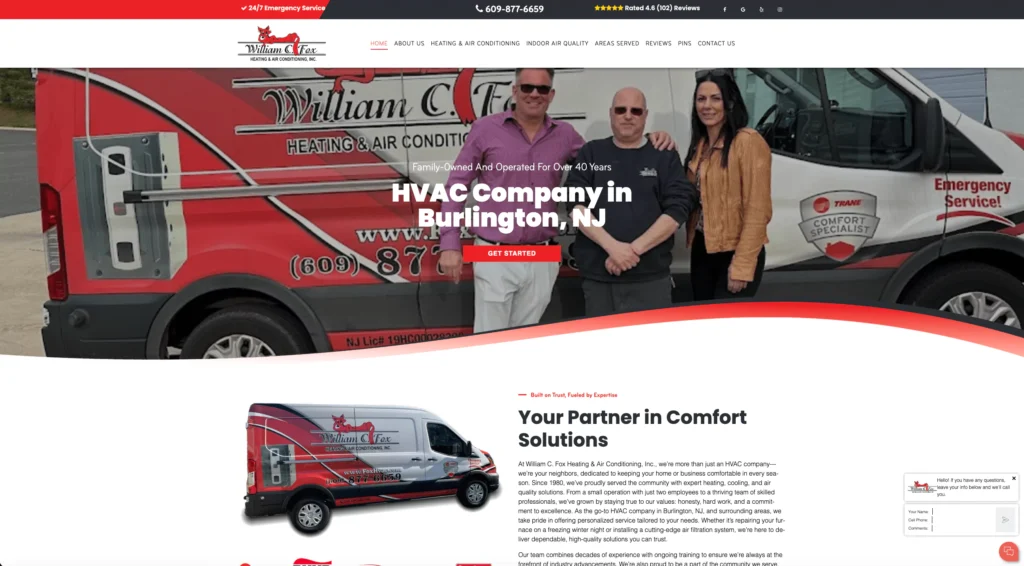
Your company website reflects your business. Your design should represent your HVAC company’s personality.
If your HVAC business focuses on commercial service, you want a professionally presented site with structure and uniformity.
However, if your company has a laid-back approach, you may want to use a broader color scheme or more vibrant design elements.
Badges, Accolades, and Testimonials
You work to get certifications and certificates that set you apart from your competition.
Ensure your site visitors know how skilled you are by prominently displaying badges and accolades with links back to the original site.
Social proof communicates your abilities to prospective customers and provides outward-facing opportunities to reputable sites within your industry.
Google’s emphasis on E-E-A-T directly ties visual proof to SEO performance and ranking potential.
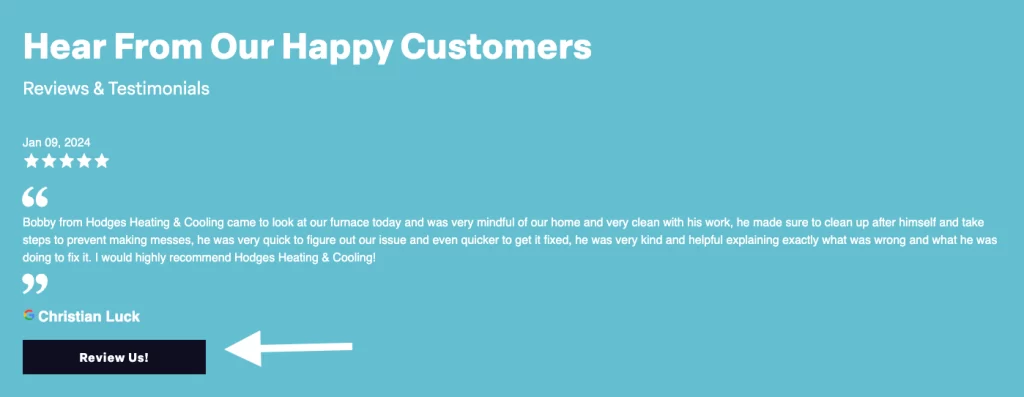
Testimonials also help promote your company by providing positive, real-life experiences to your visitors and potential customers.
You can display testimonials on your HVAC website and your Google Homepage to encourage searchers to choose your company.

Multimedia Content
In today’s online landscape, multimedia content, including videos, social media embeds, PDFs, and other interactive formats, is the best way to hold users’ attention.
In addition to providing backlinks and sharing options that boost online trust and credibility, these additions create a better user experience, leading to lower bounce rates and higher conversion rates.
Multimedia content is also ideal for sharing on secondary platforms like YouTube and social media, providing opportunities for backlinks and distribution.
Pro Tip: Upload a company video to YouTube, embed it on your website, and share it on Facebook.
Mobile Optimization
Google uses mobile-first indexing, making all HVAC websites dependent on the quality of their mobile design.
Core Web Vitals scores, INP (Interaction to Next Paint), and page experience signals are significant factors in your website’s mobile usability.
You can view these metrics within your Google Search Console experience tab.
Local SEO for HVAC
Most HVAC companies serve local customers within a defined service area. For example, your company is based in the Phoenix metro area and serves Phoenix, Glendale, Peoria, and other nearby cities.
You also want your website to appear in “near me” and map searches for consumers in these cities.
Local SEO for HVAC companies involves multiple tasks and techniques and can help you outdo your competition.
Jobsite Check-ins
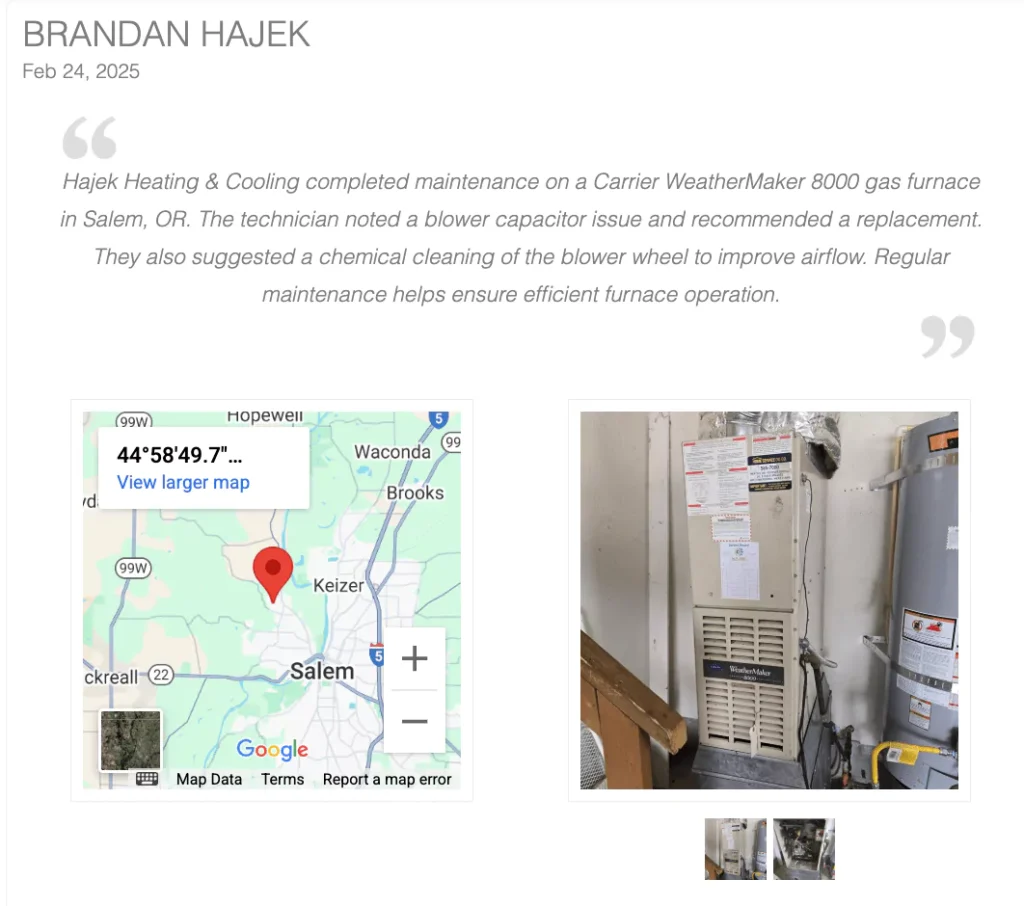
Jobsite check-ins help demonstrate experience, expertise, authoritativeness, and trustworthiness on your website’s service and location pages.
With consolidated brand signals such as schema markup, authentic job site photos, proof-based job descriptions, and location-specific geo-coordinates, check-ins build compounding authority across your service and location pages.
Google’s local pack can cite these check-ins via website justifications, while Google search, including AI Overviews and AI Mode, can also directly quote job descriptions from check-ins.
The timestamped, geolocated, and verifiable nature of check-in content is precisely what AI platforms tend to value during the retrieval-augmented generation process.
Local Business Citations
Citations are listings or mentions in other locations throughout the web that help build trust and recognition.
Local directories, such as Angi, Yelp, and BBB, are notable sources of proper citations that can boost your SEO.
Conversely, you should ignore citations from spammy and low-quality directories because they are not indexed by Google, which means they don’t transfer any ranking equity.
NAP Consistency
One way to boost your local SEO efforts is to ensure your NAP (Name, Address, and Phone number) is consistent across the web.
Your company name and contact information should be consistent across all sites where your business is listed.
NAP consistency helps Google and other search engines more easily associate your location with your other business listings, enhancing your credibility and online presence.
Google Business Profile Optimization
Your Google Business Profile (GBP) is one of the most powerful local SEO assets available to HVAC contractors, and optimizing it is entirely free.
When searchers perform a branded search or a local service query, Google typically surfaces your GBP prominently, either in the Local Map 3-Pack, a standalone knowledge panel, or increasingly, within AI-generated responses.
A fully optimized GBP includes:
- Business Categories: Select a primary category that precisely matches your core service (e.g., “HVAC Contractor”) and add secondary categories for related services like “Air Conditioning Contractor” or “Furnace Repair Service.” Categories directly influence which local queries trigger your profile.
- Services: Use the Services section to list every specific service you offer. This gives Google granular entity data about your business and increases the range of queries your profile can match.
- Photos: Upload original, high-quality photos of your team, vehicles, equipment, and completed jobs on a consistent basis. Profiles with regularly updated photos generate significantly more engagement than static ones.
- Google Posts: Use Posts to publish seasonal promotions, service announcements, and company updates. Active posting signals to Google that your profile is maintained and current.
- Q&A: Proactively populate the Q&A section with common questions homeowners ask, such as service area coverage, financing options, and emergency availability. Left unmanaged, anyone can answer these questions on your behalf.
- Review Velocity: Consistently generating new reviews matters as much as your overall star rating. A steady cadence of recent reviews signals an active, legitimate business to both Google’s ranking algorithm and AI platforms that surface local providers.
Your Google Business Profile is also eligible to rank within the Local Map 3-Pack and Google Maps results, making it a parallel visibility channel alongside your website rather than a secondary one.
City Pages
City pages are dedicated location pages for individual cities. HVAC websites often produce dozens or even hundreds of city pages.
While this strategy can work, it may also violate Google’s guidelines on scaled content abuse or doorway pages, especially if the pages are thin and low-quality.
If you deploy this tactic, provide unique location-specific context for each location page and ensure 100% unique content relevant to the precise city.
City pages should have unique content, images, and SEO elements, and provide a clear overview of your company’s offerings.
Title tags, including a top keyword and a location tag, should be used within the content to give optimal indexing to the specified area.
This way, when users perform a location-based search, such as “heater repair in Palmdale, CA,” your Palmdale city page is displayed in the search results.
On-Page SEO for HVAC Companies
On-page SEO provides Google context about each page’s intent, displayed through meta tags, images, bullet points, headers, and other styling and formatting techniques.
Google uses these details to determine what type of content is available on your site and where you’ll rank on SERPs.
Google delivers rankings at the page level, meaning the page most relevant to the user’s query should appear (assuming there is no technical SEO error).
Keyword Placement
Keyword placement helps Google understand your page’s context and topical relevance, but its algorithm has advanced to process and understand language beyond keywords alone.
Your primary keyword for each page should appear within the title tag, H1, URL slug (if possible), and the first paragraph of the page’s body content.
Avoid overusing that keyword elsewhere on the page, as the sections I’ve outlined are more than enough to provide Google and other search engines with the context they seek.
Throughout the rest of your page, follow these guidelines:
- Use Keyword Variations
- Use Natural Language (or NLP style writing)
- Format Pages With a Topical Hierarchy
Google’s modern algorithms are more intelligent than mere keyword recognition. They incorporate entity recognition and topical depth more than the old-school concept of keyword density.
Title Tags
Title tags help search engines and AI platforms understand your page’s topic and match it with the user’s query and intent. An ideal HVAC title tag includes:
- Primary Keyword
- Local Context (i.e., City Name)
- Brand / Company (When Useful)
- 60 or Fewer Characters (to avoid SERP Shortening)
Example: AC Repair in Plano, TX | JimBob’s Mechanical
Remember to align your content and formatting (headers and topical hierarchy) with your title tag’s intent so that users “get what they came for.”
Google’s algorithms can detect when a title tag misleads readers and are likely to reduce its ranking.
Meta Descriptions
While meta descriptions have a negligible impact on SEO rankings, they do impact click-through rates (CTR), an indirect ranking factor.
A suitable HVAC meta description contains:
- Clear and Compelling Messaging
- 150-160 Characters
- Primary Keyword
Example: JimBob’s Mechanical Offers Efficient and Reliable Air Conditioning Repair Services in Plano, TX. Our Trained Staff Members Provide 24/7 Emergency Services!
Header Tags
Header tags create a topical hierarchy that helps visitors and search engines understand your page.
The best practices for HVAC page headers include:
- Use Only One H1, Which Should Either Match or Closely Resemble Your Title Tag
- Use H2s and H3s for Main Sections and Subsections
- Keep Headers Between 20-70 Characters
- Utilize Secondary Keywords When Applicable
Well-structured header tags help your pages rank in traditional search results and in Google’s AI Overviews.
Google uses headers when generating AI responses and summaries for specific search queries.
URL Slugs
A URL slug (or permalink) is the end part of your page URL.
For HVAC websites, a URL slug should be:
- Concise
- Descriptive
- Keyword-rich
- Hyphen-separated
- Lowercase
Bad URL Slug: myhvacwebsite.com/page?id=342492433432131
Good URL Slug: myhvacwebsite.com/services/gas-furnace-repair
While URL slugs might seem insignificant on the surface, they actually have a significant impact on how search engines interpret your pages, including in the context of the rest of your website.
Image Alt Text
Alt text is essential to image indexing on Google and other search engines and can also help your pages rank higher in organic and AI search results.
Image Alt text for HVAC websites should:
- Clearly Describe The Image’s Content
- Include Relevant Keywords Where Applicable
- Avoid Keyword Stuffing
Alt text should be reserved not only for the images you hope to rank but also for every image file on your website to build sitewide topical relevance.
Alt Text Example: Tech Repairing AC Unit in Plano, TX
Images with accurate and descriptive alt text may appear in featured snippets and AI-generated responses.
Other SERP Ranking Factors
Google and other search engines use various sources of information to provide helpful search results for their users.
While on-page and site-wide SEO are crucial, other factors also affect your business’s visibility. Rather than a single tipping point, a collection of factors influences SERP position.
Established Trust Signals
While third-party metrics such as Domain Authority and Domain Rating are not used by Google, Google likely has its own scoring system for gauging your domain’s trustworthiness.
A site that is ten years old and has naturally accumulated backlinks and citations over time is more established than a site that is six months old and relatively new to the online ecosystem.
HVAC companies with older indexed domains, even if they’ve not been fully optimized for SEO, can typically increase visibility more quickly than a company launching a brand new domain.
Reviews
Reviews also impact how your brand is reflected online. As your clients leave reviews of your company on different platforms, Google considers them when measuring your reputation.
Reviews are also displayed on your Google knowledge panel, showing prospective clients what level of quality they can expect from your company.
Search platforms, including Google AI Mode, typically cite reviews from multiple platforms, so it’s vital to encourage your clients to leave reviews on multiple platforms, such as Facebook and BBB, to ensure comprehensive coverage for your HVAC business.
Location
Your business location directly impacts how well your Google Business Profile ranks within the Map 3-Pack.
If your address is on the outskirts of a city or in a Census Designated Place (CDP), you will get fewer Google Maps impressions.
Conversely, an address near the city’s center (or centroid, as Google Maps defines it) can help you quickly generate impressions, even as a newer HVAC company.
Measuring SEO Success
As with any business plan, your SEO campaign should be tracked through analytics to ensure its effectiveness.
While traffic and clicks do not capture the full impact of SEO, especially as zero-click searches increase, measuring performance remains essential for your SEO campaign.
Google and many other platforms offer helpful ways to measure your SEO success, such as first-class analytics that enable you to create valuable, productive progress reports.
Google Analytics
Google Analytics is Google’s proprietary tracking platform. It allows HVAC companies to measure website performance through various metrics, including users, organic visits, and direct visits.
While the latest version, GA4, has a slightly steeper learning curve than the previous version, it remains the most accurate and insightful platform for tracking SEO performance.
Google Business Profile Insights
With your Google account, you can access Google Business Profile Insights to help track your local performance.
This platform tracks metrics like calls from Google Business Profile, website clicks, and impressions. GBP insights also lists common terms or phrases that prompt your profile to appear in search results.
Google Search Console
Google Search Console is another Google tracking platform tailored explicitly to organic search performance.
While it doesn’t track other visitors (as Google Analytics does), it provides highly accurate and valuable insights into your organic search performance.
With GSC, HVAC companies can evaluate which pages are being clicked on via organic search and which queries are being used to find them.
3rd Party Tracking Tools
Platforms like SEMRush, Moz, and Ahrefs provide useful metrics and analytics to assess the effectiveness of your marketing plan.
However, these tools are less accurate than Google’s because they rely on estimates rather than raw internal data.
That’s why you should avoid solicitations from marketing companies that evaluate your website performance only using third-party tools.
Next Level SEO Tips for HVAC Companies
Google’s recent algorithm updates, including the Helpful Content Update, have increased the power of E-E-A-T or expertise, experience, authoritativeness, and trustworthiness.
Heating and cooling websites that best demonstrate these qualities through branded signals will rank.
SEO remains the most affordable way to generate HVAC leads online. However, some tactics that previously led to consistent rankings on search engines are no longer viable.
As a result, HVAC companies must adapt to maintain or increase their Google visibility.
Tip 1: Implement Digital + Branded Signaling
An HVAC company website should not aim to trick search engines but rather establish a brand that search engines can trust enough to present to its users.
By treating your business as an entity that can be strengthened by its associations with customer reviews, specific locations, and non-commodity content, you gain a better understanding of the modern SEO prism.
For many HVAC websites, this means retiring your strategy of publishing 3 low-level blog posts per month and focusing more on sharing content based on authentic HVAC jobs in your area and the customer experiences tied to those projects.
Tip 2: Create Multi-Channel Brand Synergy
While a robust website is the most integral part of an SEO strategy for HVAC professionals, it’s not enough to establish a viable brand for your services.
Your other digital entities, like your Google Business Profile and social profiles, should also link to your website.
For example, consider Google Maps and YouTube, both of which are regularly integrated into Google search results.
Ensuring your HVAC company can rank on Google’s Local Map 3-Pack, video carousel, and traditional organic results epitomizes SEO synergy.
Tip 3: Optimize for User Intent
Google’s priority is its users (those searching for HVAC services). As a result, you must view your website as Google’s partner and something that can help satisfy their users’ search experience.
If a local HVAC prospect searches for gas furnace repair services, they intend to find content that clearly outlines these services and is backed by expertise and experience.
User intent also applies to the website’s location, as local homeowners seek contractors who can reasonably commute to their homes.
Tip 4: Understand that Good AEO is Good SEO
Appearing in AI responses on Gemini, ChatGPT, and other platforms ultimately comes down to implementing best SEO practices.
The disconnect some HVAC companies are experiencing is that they’re relying on outdated SEO tactics, resulting in lackluster visibility in AI.
By reevaluating and modernizing your SEO strategy to focus more on user experience, non-commodity content, and sound technical architecture, you simultaneously increase your chances of appearing in AI search results.
Next Steps for HVAC Companies
AI hasn’t reduced the impact of SEO for HVAC lead generation; it’s increased the need for implementing modern best SEO practices in your marketing campaign.
HVAC companies that build genuine brand authority through consistent, non-competitive content, social proof, and multi-platform visibility are expanding their presence across Google Search, Google Maps, AI Overviews, AI Mode, and third-party AI platforms such as ChatGPT and Claude.
By implementing the SEO strategies outlined in this guide, you position your HVAC business to maximize visibility across all relevant platforms, an investment in the concept of search everywhere optimization.
As a long-time SEO company for HVAC professionals, we offer month-to-month services to help you achieve your digital marketing goals.
If you need a comprehensive SEO strategy with the industry’s highest implementation standard, reach out for a free consultation.

Author: Nolen Walker
Nolen Walker is the founder of HVAC Webmasters and the creator of DataPins™, a Local SEO platform for HVAC companies. He has over 16 years of experience helping HVAC businesses grow through organic search, Google Maps, and AI-driven visibility.
Nolen is the author of
A Complete SEO Guide for the HVAC Small Business Owner.
He also hosts
The HVAC Marketing Plan Podcast
and
The Nolen Walker Podcast
on Spotify.