
The global HVAC system market is projected to grow to $407.77 billion by 2030 at a 6.4% CAGR, attracting new competitors to the home services space each year.
Businesses entering this market need a predictable way to generate or buy HVAC leads and convert them into paying customers.
As a digital marketing agency for HVAC companies, we’ve worked with companies across the United States to help them generate leads through Google, ChatGPT, and other channels.
The nine methods below cover HVAC lead generation for established companies and, where the approach differs, for solo operators and newer businesses with smaller budgets.
Key Takeaways
- Google SEO and AEO (Answer Engine Optimization) remain the highest-ROI channels for HVAC companies over time, though they take longer to produce results than paid options.
- Local Services Ads and Google Ads charge per lead or per click, respectively, and both work best layered on top of an optimized Google Business Profile.
- Email marketing and referral programs depend on an existing customer base or subscriber list, so they are secondary channels rather than starting points.
- A business’s size, budget, and review history change which of these methods makes sense first. That context is called out under each method below.
- None of these channels works in every situation. The conditions are noted so you can rule out what won’t fit your business before spending on it.
1) Google SEO
Google SEO remains the highest-ROI channel for HVAC companies, delivering the lowest cost per lead once a website is established.
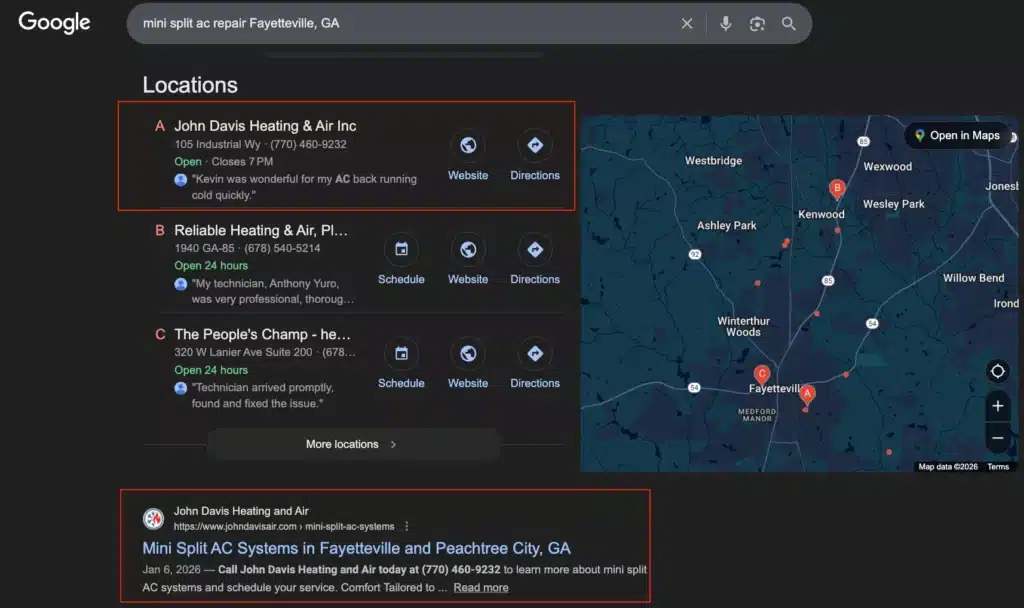
Google’s organic results include three components: traditional search listings, the Local Map 3-Pack, and AI Overviews. Appearing across all three makes a company the obvious choice for homeowners searching in its service area.
Google’s ranking systems, including the May 2026 core update, reward websites that demonstrate real, verifiable expertise. HVAC websites can support this by publishing recent project photos, listing manufacturer certifications, and maintaining detailed service pages rather than generic ones.
Title tags, on-page text, citations, and credible backlinks across the web remain foundational ranking factors even as Google’s ranking systems grow more sophisticated.
A fully optimized Google Business Profile is required to appear in the Local Map 3-Pack for local search queries.
When this doesn’t work: SEO is a poor fit for a business that needs leads within 30 days. A new website with no existing authority typically needs six to twelve months before rankings produce meaningful lead volume. Solo operators without time to maintain a website should expect to pay for ongoing content work, since this channel does not run itself.
2) Answer Engine Optimization (AEO)
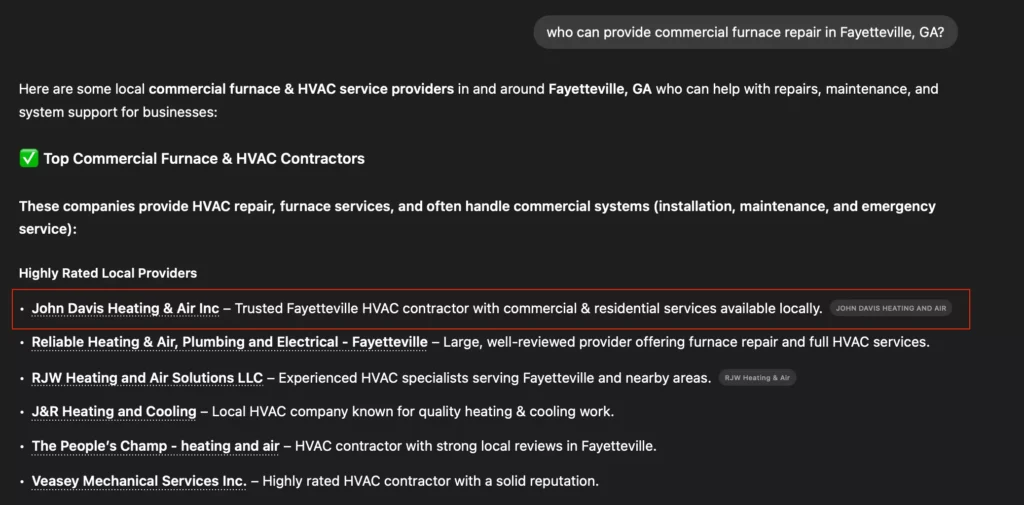
Answer Engine Optimization (AEO), also known as Generative Engine Optimization (GEO), is the newest lead generation method available to HVAC companies.
AEO overlaps substantially with traditional SEO, but requires additional structural work to earn placement inside AI-generated answers.
AEO is not limited to Google’s AI systems. It also applies to ChatGPT, Perplexity, and other AI search platforms that generate answers from web content.
Most AI search platforms run a query fan-out process: a single user prompt triggers multiple simultaneous searches, and the results are synthesized into one response.
HVAC websites that structure content to answer specific, self-contained sub-questions are more likely to be cited and recommended inside these AI-generated responses.
When this doesn’t work: AEO is ineffective for a website that hasn’t first addressed basic SEO fundamentals (clear service pages, working contact information, technical crawlability). Layering an AEO structure onto a thin or outdated website will not produce visibility on AI platforms.
3) Website Conversions
Website conversions can make or break the consistency of lead generation, even as more searches end without a click on any website.
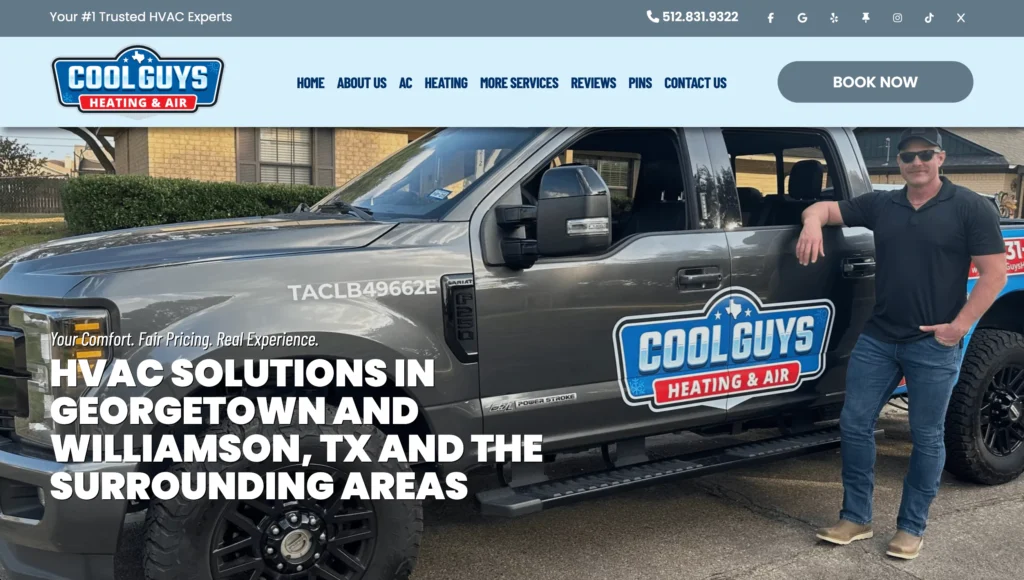
A homeowner typically reaches a company’s website after discovering the brand through an AI platform or search result, at which point the website itself decides whether that visitor becomes a lead.
Three factors drive this decision:
- Calls to action. Prominent, simple booking or inquiry options are essential, since visitors expect an immediate way to request service.
- Design and navigation. Outdated design or confusing navigation causes visitors to leave before making contact.
- Site speed. Pages that take more than three seconds to load lose a significant share of visitors before they see any content.
When this doesn’t work: A high-converting website cannot compensate for a business with no incoming traffic. Conversion optimization only matters after SEO, AEO, or paid channels are already sending visitors to the site.
4) Review Management
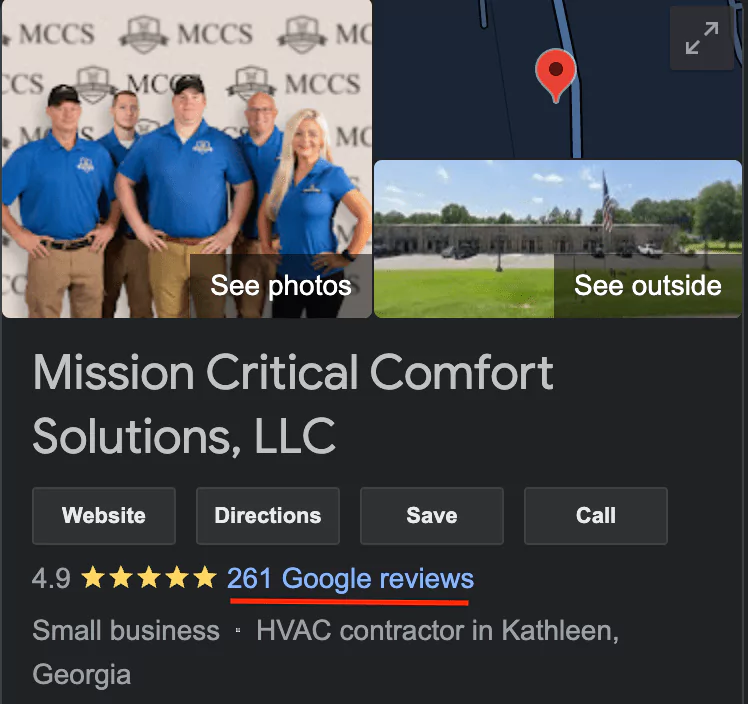
Prospects become leads once they trust a business enough to make contact, and consistent online reviews are the primary driver of that trust.
Google reviews carry the most weight for conversions, though Facebook Recommendations and Yelp reviews also shape a prospect’s view of a business.
Automating review requests after every job, then following up with technicians asking customers directly, produces the most consistent review volume.
Reviews should also be displayed directly on a company’s website, not left solely on third-party platforms.
Review volume affects visibility as well as trust: 47% of consumers won’t use a business with fewer than 20 reviews, and reviews now account for 20% of local pack ranking weight, up from 16% in 2023.
A study from Sterling Sky confirms that review velocity (the recency of reviews) is more impactful than total review count, highlighting the importance of a continuous review management approach rather than a “set and forget” approach.
When this doesn’t work: A company with zero reviews may struggle to get enough business for a review request process to yield notable returns. In addition, review generation requires an operational habit (asking at the point of service) that some smaller teams don’t yet have staff capacity to run consistently.
5) Email Marketing
Email marketing is a legitimate, high-return lead generation method once a company has an established customer base, though it depends more heavily on other channels than SEO, AEO, or paid advertising do.
For every $1 spent on email marketing, businesses see an average return of $36, a 3,600% ROI, making it one of the highest-return channels available once a list exists.
Segmenting subscribers by service type, location, and other variables produces meaningfully higher engagement: segmented campaigns see 30% more opens and 50% more clickthroughs than non-segmented campaigns.
Building a subscriber list in the first place relies on visibility from SEO and AEO, which is why email marketing works best as a second-stage channel rather than a starting point.
When this doesn’t work: Email marketing produces poor results for a small or unsegmented list, since a lack of segmentation is the most common cause of underperformance. A brand-new company with no subscriber list shouldn’t expect email to generate leads until SEO or paid channels build that list first.

6) Facebook (Meta) Ads
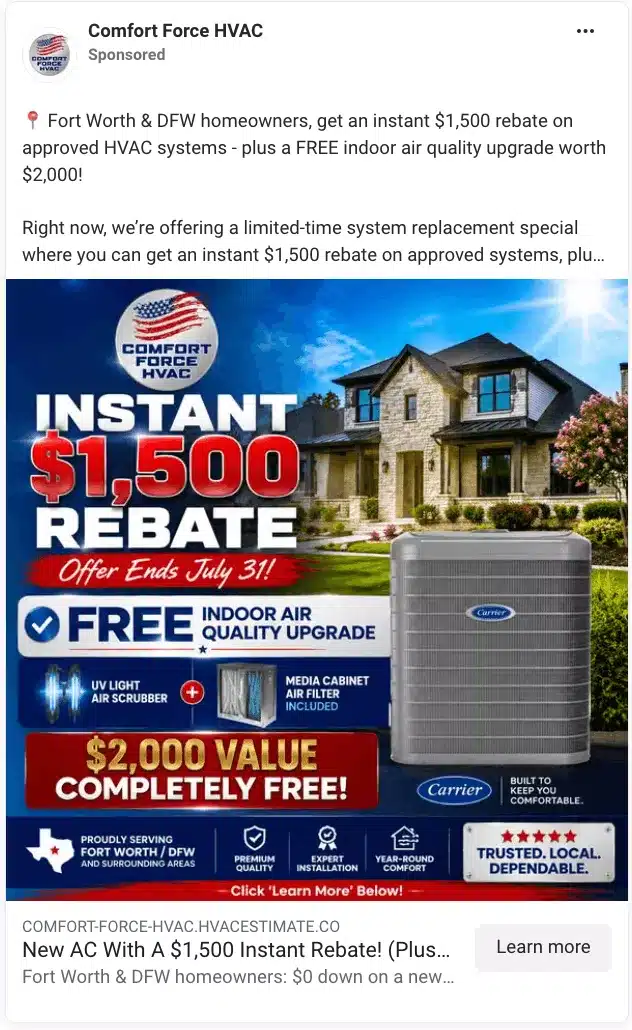
Facebook Ads remain an accessible paid channel for HVAC companies, though cost per click has increased industry-wide over the past two years and now runs meaningfully higher for home-services categories than for lower-competition verticals.
Facebook is the most active social platform among U.S. homeowners, the primary audience for most heating and cooling campaigns.
Facebook Ads perform best for product-driven campaigns, but local contractors can achieve solid results with the right creative approach.
A clear value proposition, ideally delivered in short-form video, is the strongest driver of lead generation on this platform.
Since Meta operates both Facebook and Instagram, ads can run across both platforms from a single campaign to maximize reach.
When this doesn’t work: Facebook Ads underperform for companies without the capacity to produce video creative, since static image ads generally convert at a lower rate for service businesses. This channel also works poorly as a standalone strategy disconnected from a company’s broader brand presence, since cold traffic unfamiliar with the business converts inconsistently.
7) Local Services Ads (LSA)
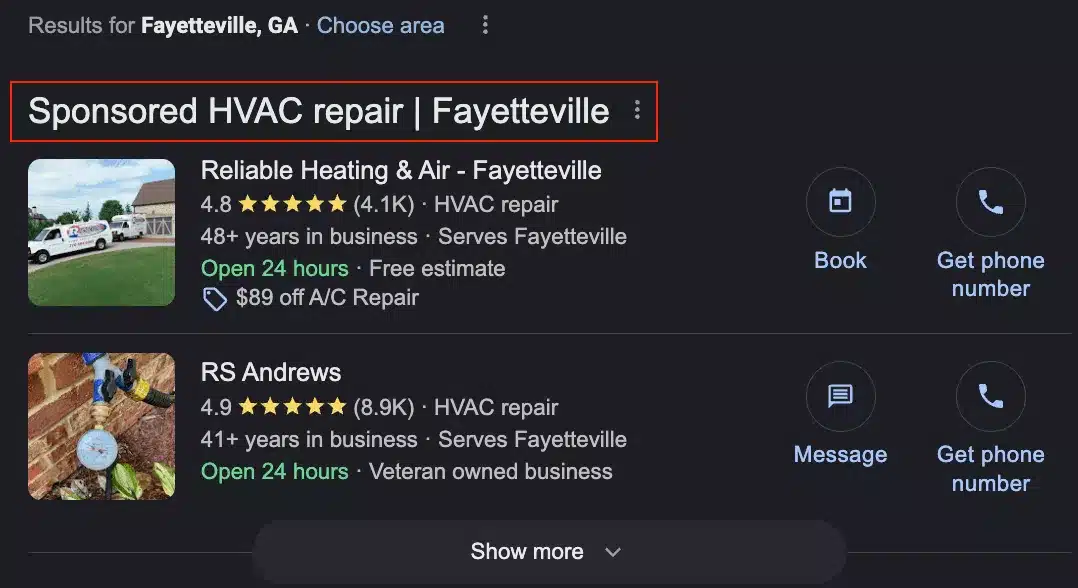
Local Services Ads place HVAC companies in a row of boxes at the very top of local search results, each showing star ratings and a “Google Verified” badge.
Eligibility requires passing a Google background check. Companies that fail this check are not eligible to run Local Services Ads at all, which rules the channel out entirely rather than simply increasing its cost.
Unlike standard pay-per-click campaigns, LSA charges only for qualified leads, not clicks.
Cost per lead varies by market size, season, and review profile rather than sitting at one fixed number. Based on client work across different service areas, cost typically rises in larger metros and during seasonal demand spikes (sudden cold snaps or heat waves), and companies with stronger review profiles tend to see more favorable per-lead pricing.
LSA performs best when paired with an active local SEO effort, including consistent review generation and a fully optimized Google Business Profile.
When this doesn’t work: LSA is unavailable to any company that fails the background check, regardless of budget. It also performs poorly for companies with thin review profiles, since LSA ranking and lead volume are tied to review count and responsiveness, not just bid amount.
8) Referral Programs
Referral programs incentivize existing customers to recommend a company to friends and family. Incentive options include:
- Limited-time discounts
- Lifetime discounts
- Tiered discounts based on number of referrals
- Gift cards
- Smart home upgrades
- VIP membership
- Exclusive product access
- Event tickets
Referrals are among the oldest lead generation methods because word of mouth predates digital marketing and still carries more weight than reviews for many consumers.
Modern referral programs integrate with digital marketing campaigns, which helps them spread faster than word-of-mouth alone.
When this doesn’t work: Referral programs fail when service quality doesn’t match the incentive being offered. A referral program layered on top of inconsistent technician performance will damage a company’s reputation faster than it grows it, since referred customers arrive with higher expectations.
9) Community Sponsorships
Community sponsorships, such as sponsoring a Little League team or a local event, build brand trust in a service area over time.
Increased brand awareness from sponsorships can improve conversion at other touchpoints, including organic search, as more people in the service area recognize the name.
A single sponsorship can influence a brand’s local reputation across several channels at once, from in-person word-of-mouth to search behavior.
When this doesn’t work: Sponsorships produce little return for a company with poor reviews or inconsistent service, since community goodwill cannot offset a bad customer experience. This channel also takes longer to show measurable lead impact than paid channels, so it is not a fit for a company needing leads immediately.
Comparing HVAC Lead Generation Methods
| Method | Cost Structure | Time to Results | Best For |
|---|---|---|---|
| Google SEO | Ongoing content/technical investment | 6–12 months | Established businesses building long-term, low-cost leads |
| AEO | Builds on SEO investment | 6–12 months, after SEO foundation | Businesses already ranking organically |
| Website Conversions | One-time + maintenance | Immediate, once traffic exists | Any business already generating traffic |
| Review Management | Staff time / software | Weeks to months | Any business, especially those under 20 reviews |
| Email Marketing | Low cost per send | Immediate, once list exists | Businesses with an existing customer list |
| Facebook Ads | Ongoing ad spend | Days to weeks | Businesses with video creative capacity |
| Local Services Ads | Pay per qualified lead | Days, after background check | Businesses that pass Google’s background check |
| Referral Programs | Incentive cost per referral | Weeks to months | Businesses with strong, consistent service quality |
| Community Sponsorships | Sponsorship fee | Months | Established businesses building long-term local trust |
Choosing Between Channels
Solo operators and newer companies with limited budgets should prioritize Google Business Profile optimization and review generation first, since both are low-cost and support every other channel on this list.
Local Services Ads and referral programs follow once a review base exists. Facebook Ads and email marketing suit companies that already have brand recognition or an existing customer list, since both perform worse starting from zero.
Final Thoughts
Finding your ideal combination of channels to generate HVAC leads often involves trial and error, but you can avoid some common mistakes by taking an honest look at your company’s current positioning.
No single channel on this list works for every HVAC business. The right combination depends on budget, review history, and how quickly leads need to arrive, which is why the comparison table and channel-selection guidance above matter more than any single tactic.
Reviewing the conditions for each method is the fastest way to rule out what won’t work before spending on it.

Author: Nolen Walker
Nolen Walker is the founder of HVAC Webmasters and the creator of DataPins™, a Local SEO platform for HVAC companies. He has over 16 years of experience helping HVAC businesses grow through organic search, Google Maps, and AI-driven visibility.
Nolen is the author of
A Complete SEO Guide for the HVAC Small Business Owner.
He also hosts
The HVAC Marketing Plan Podcast
and
The Nolen Walker Podcast
on Spotify.